This summary of Why Nations Fail by Nobel Prize winners Daron Acemoglu and James Robinson explains how institutions are key to understanding why some nations succeed and others fail.
[Estimated reading time: 27 mins]
Buy Why Nations Fail at Amazon (affiliate link)
Table of Contents
Key Takeaways from Why Nations Fail
- Nations fail or succeed primarily because of their institutions, rather than because of their geography, culture, or ignorance:
- Inclusive institutions distribute power broadly in society.
- Extractive institutions concentrate power and wealth in the hands of a narrow elite, leading to poverty and stagnation.
- Economic growth under extractive institutions is possible, but only temporarily. Real, sustainable growth requires creative destruction. Elites tend to block this under extractive institutions, because it threatens their power.
- Both inclusive and extractive institutions are persistent, because of self-reinforcing dynamics:
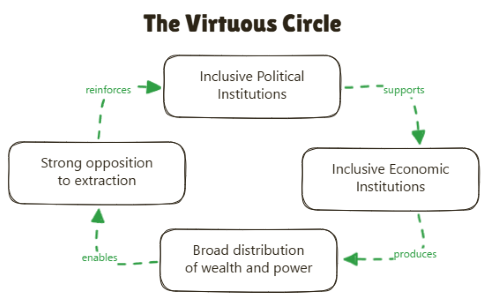
- Virtuous circle. Inclusive institutions create a more equal distribution of resources and empower citizens, which makes repression more difficult over time.
- Vicious circle. Extractive institutions persist because they generate the resources elites need to maintain their power. Even if one group of elites is displaced, it may just be replaced by other elites while the extractive systems stay in place.
- History is not predetermined. Large institutional differences can often be traced back to past contingencies:
- Critical junctures can disrupt existing power dynamics and set societies on different paths.
- Small initial differences between societies grow over time through a process called institutional drift.
- How to get inclusive institutions?
- Some degree of political centralisation is needed to provide a basic level of order for markets and systems to function.
- Revolutions or movements made up of broad coalitions with diverse interests are more likely to lead to inclusive institutions.
- Foreign aid often fails because it doesn’t change the underlying institutions. But foreign aid that is funnelled at grassroots opposition may be more successful.
- Free media also plays a crucial role in giving broad coalitions the information they need to coordinate, which explains why authoritarian governments are so determined to control the media.
Detailed Summary of Why Nations Fail
Nations succeed or fail because of their institutions
Many people have tried to understand why some countries are rich while others are poor. Acemoglu and Robinson argue that it is a country’s institutions that determine its success, rather than alternative explanations like geography, culture or ignorance.
More specifically, successful countries have inclusive institutions that broadly distribute wealth and power, while unsuccessful countries have extractive institutions that concentrate power among a small elite.
Why it’s not geography
Some have pointed out that many poor countries tend to be in tropical climates with high disease burdens, while rich countries tend to enjoy more temperate climates. However, this cannot account for the vast income differences between North and South Korea, East and West Germany, or the city of Nogales. Moreover, if you look back further in history, you do see instances where civilisations in tropical areas were richer than those in temperate ones.
Example: Nogales, a city cut in half
The city of Nogales sits on the US-Mexico border, divided by a fence.
In the US half, average household income is about $30,000 a year. Residents have good access to services such as electricity, sewage systems, public health, a decent road network and law and order.
In the Mexican half, average household income is closer to $10,000 a year. Roads are in bad condition and crime is high.
There is no difference in geography, climate, or the types of diseases prevalent in each half of Nogales. The key difference is the institutions. In the US half, Nogales residents have long enjoyed democratic rights. By contrast, until 2000, the Mexican half was under the corrupt control of a single party.
Or culture
The authors then rule out culture (e.g. the Protestant work ethic) as an explanation. There are many places that had similar cultural origins but developed very differently, such as:
- Some English colonies (Canada, the US) are very wealthy but other English colonies (Sierra Leone, Nigeria) are incredibly poor.
- Argentina and Uruguay have larger European populations than the US and Canada, but are considerably poorer.
- North and South Korea were culturally identical in 1950, but the latter is much richer today because of its institutions.
Or ignorance
Lastly, the authors reject the ignorance hypothesis — the idea that some nations are poor because their leaders simply don’t understand how to make them rich. While there are examples of leaders adopting terrible policies out of ignorance, this only explains a small part of global inequality. The main reason countries with bad economic policies don’t accept better ones is because of how their incentives are set up.
Bad economic policies are usually chosen because they’re good politics, not because their leaders thought they were good economics.
Example: Healthcare in India
In theory, public healthcare in India is widely available and cheap. But in practice, even the poorest Indians use the much more expensive, unregulated, and sometimes deficient private providers. The reason is because the government healthcare facilities are unavailable most of the time — they are plagued by absenteeism, so are usually closed.
There was one proposal to fix this absenteeism by introducing time cards, and nurses were meant to clock in and out every day. This didn’t work. The health administrators sabotaged the program because they were in cahoots with the nurses and themselves contributed to the absenteeism problem.
What are inclusive and extractive institutions?
Inclusive institutions are those that enable the majority of people to make their own choices and encourage them to participate in economic activities that make the best use of their skills. This typically includes things like:
- Secure property rights, which create incentives for people to save, invest and innovate.
- Rule of law, under which everyone is equally subject to the law. When many different groups have some degree of political power, it’s only logical that they should all be treated fairly and equally.
- Free media. A free media makes it more likely that threats against inclusive institutions will be widely known and resisted. Rulers in extractive political institutions generally want to control the media to prevent serious opposition to their power.
- Few monopolies. When markets are dominated by a few firms charging exorbitant prices and blocking new entrants, they stop being inclusive. Inclusive markets should create a level playing field and economic opportunities for most of the population.
In contrast, the vast majority of societies throughout history have had extractive institutions, which are designed to extract incomes and wealth from one subset of society to benefit a different subset.
Example: Slavery as a quintessential example of an extractive institution
Before the slave trade began, African societies were mostly small-scale with some legitimate (albeit limited) political authority.
The slave trade pushed many societies towards absolutism — people could get rich from capturing and selling people, instead of working with them, there was no need to build inclusive institutions. In some cases, the slave trade did aid the rise of powerful states, but the wars and slavery destroyed whatever legitimate political authority was left. Laws were distorted to further the slave trade; the penalty for every crime became slavery.
Even after the slave trade ended in 1807, the impact of extractive institutions remained. Many African states had already become organised around slaving so, slaves were simply redeployed within Africa instead of being sold off to the Americas. Slavery in Africa expanded throughout the 19th century and, in many parts, continued even into the 20th century.
Political and economic institutions are interlinked
All economic institutions are ultimately created by political institutions. Politics is the process by which we choose the rules that govern society.
Traditionally economics has ignored politics, but understanding politics is crucial for explaining world inequality.
— Acemoglu and Robinson in Why Nations Fail
If political power is narrowly held, then a small group of political elites can set up economic institutions to enrich themselves at the expense of the rest of society. In contrast, if political power is broadly distributed and constrained by checks and balances, economic power will be too.
Example: Banks in different countries
Banks are naturally monopolistic and profit-driven. But the profit motive is channelled differently in a country like the US than in a country like Mexico, because of their different institutions and political incentives.
In Mexico, politicians could set up state banking monopolies and give them to their friends and partners in exchange for part of the monopoly profits. But this didn’t work in the US because of the political incentives. Politicians who tried to create such banking monopolies for their friends would lose future elections, so banking monopolies crumbled.
Political institutions include, but are not limited to, written constitutions and whether the society is a democracy. We also need to consider broader factors that determine how political power is distributed in society, such as the ability of different groups to act collectively to pursue their objectives or to stop other people from pursuing theirs, and the state’s power or capacity to govern society.
Economic growth under inclusive vs extractive institutions
Some degree of economic growth under extractive institutions is possible — after all, elites need to generate some wealth, else there would be nothing to extract.
But the authors argue that such growth isn’t sustainable under extractive institutions, for two reasons:
- Creative destruction. Long-run, sustainable growth involves innovation and creative destruction. Elites are afraid of creative destruction because it risks disrupting existing power structures, since elites are (almost by definition) those that benefit from the status quo.
- Infighting. Since wealth and power under extractive institutions is highly concentrated, elites have greater incentives to fight for control. When power is so unequally distributed, the winning or losing power simply comes with much higher stakes. But infighting is inefficient and causes political instability, which may even lead to the breakdown of law and order.
When extractive institutions create huge inequalities in society and great wealth and unchecked power for those in control, there will be many wishing to fight to take control of the state and institutions.
— Acemoglu and Robinson in Why Nations Fail
Example: Roman emperors suppressing creative destruction
According to Pliny the Elder, the Emperor Tiberius executed a man who claimed to have invented unbreakable glass, because he was worried it would reduce the value of gold.
Similarly, the Emperor Vespasian refused to use an innovation for transporting columns more effectively (though he didn’t kill the man) because he wanted to keep the plebians busy and pliant. His fear was that the new device would be too destabilising.
Example: Soviet Union’s growth under extractive institutions
Between 1928 and 1960, the USSR grew at around 6% annually, by reallocating resources from subsistence farming to industrial production. But this was catch-up growth, driven by resource allocation rather than innovation or creative destruction.
There were no incentives to innovate, because innovating requires experimentation, and experimentation is risky. If an experiment doesn’t work out, you may miss your production targets. Moreover, since output targets and bonuses were determined top-down based on previous production, managers were incentivised to undershoot targets, so that future targets would be lower. Although the government introduced explicit “innovation bonuses” to promote growth in 1946, these weren’t very successful.
In the 1970s, after the low-hanging fruit from reallocating underutilised resources had been plucked, growth stalled.
Institutions are persistent
The global income rankings today look pretty similar to those 50, or even 150, years ago because most of the world inequality we see today emerged during the Industrial Revolution. That inequality has persisted because of virtuous circles that reinforce inclusive institutions and vicious circles that reinforce extractive ones. These circles explain why reducing world inequality is so difficult.
Example: Spanish vs English colonisation
The Spanish conquered the Aztec and Incan civilisations, which had very dense local populations. This density made it easy for the Spanish to set up (or perpetuate) highly extractive institutions — they forced indigenous people’s living standards down to a subsistence level and extracted all the surpluses for themselves.
When the English arrived in Virginia, USA, they tried to do the same. But it didn’t work. There was no gold or precious metals, and the indigenous people were too spread out. The population density was about 1/500th that of central Mexico. The Virginia Company struggled even to make English settlers work — if conditions got too harsh, they’d just ran away to live with the locals. So, starting in 1618, the Virginia Company began to give settlers farmland and incentives to work. In 1619, settlers received voting rights. A similar story happened in the other US colonies.
The different institutions set up by the Spanish and the English have persisted until today. The US continued developing inclusive institutions that created incentives for productivity, while Latin America became highly unequal and politically unstable. Most Latin American countries didn’t become democracies until the 1990s, and even then they were very unstable.
[This example seems to suggest geography played quite a big role in why certain countries are richer than others though, of course, not a determinative role.]
Combinations of extractive and inclusive institutions are generally unstable. Extractive economic institutions are unlikely to survive for long under inclusive political institutions. Similarly, inclusive economic institutions don’t tend to be supported by extractive political ones.
The virtuous circle
Inclusive political institutions tend to support inclusive economic institutions, which leads to a more equal distribution of income. This more equal distribution empowers a broad segment of society, making it harder for any one group or individual to usurp power. Anyone who tries to set up extractive economic institutions for their own benefit will face political opposition.
Example: How England developed inclusive institutions
England developed inclusive institutions gradually, helped along by the virtuous circle. Beginning with the Magna Carta in 1215, the king’s power was limited, as he was forced to consult barons before raising taxes. In 1265, Parliament was created. Though it consisted solely of elites, Parliament still empowered a broader section of society than before, and consistently resisted attempts by Tudor and Stuart kings to consolidate power. This came to a head in a civil war in 1642. Parliament wanted to end absolutist political institutions, while Charles I wanted to strengthen them. Parliament won, and Charles was executed in 1649.
A few decades after, during the Glorious Revolution of 1688, power genuinely shifted to Parliament. This led to a raft of reforms: the Bill of Rights 1688, parliamentary consent for taxation and standing armies, stronger property rights, and the creation of the Bank of England. State capacity increased, but with pluralistic oversight.
These changes set the stage for the Industrial Revolution, which was driven mostly by new entrants (only about 20% of the leading industrialists had previous manufacturing experience). New industrial centres like Manchester and Birmingham grew wealthy and began to demand political power through riots and protests. Parliament responded with a series of Reform Acts which extended voting rights to more and more people. Notably these reforms were not granted out of altruism, but to preserve elite rule and stave off revolution.
British democracy was not given by the elite. It was largely taken by the masses.
— Acemoglu and Robinson in Why Nations Fail
These expanded voting rights fed back into inclusive economic reforms: the Corn Laws protecting landowners were repealed; the civil service was made more meritocratic; workers gained legal protections; taxes were made progressive; and education became freely available.
But while the virtuous circle can still be broken. There have been repeated challenges to inclusive institutions over the years, and there is no guarantee the institutions survive.
Example: The rise and decline of Venice
In the Middle Ages, Venice may have been the richest place in the world, thanks to its inclusive economic institutions and somewhat inclusive political institutions. During this period, there was a great expansion of trade across Europe, and Venice was well-positioned (literally) to take advantage of it.
A particularly inclusive economic institution was the commenda, a type of partnership that involved a sedentary partner (who stayed in Venice) and a travelling partner (who sailed with the cargo). The sedentary partner would put in most of the capital, while the travelling partner would put in the work. The commenda was a key means of upward social mobility, as it allowed young people without wealth to build some up.
As young entrepreneurs grew richer, they began to demand political rights. Those political rights led in turn to institutional innovations in law (e.g. courts, contracts, bankruptcy and business structures) as well as finance. The origins of modern banking began around this time in Venice.
But all this economic growth came with the forces of creative destruction, which threatened existing elites. Political tensions steadily grew during the beginning of the 14th century, and the elites made a switch toward more extractive political and economic institutions. They banned the commenda contracts that had made Venice rich in the first place and, starting in 1314, the Venetian state began to limit long-distance trade to only the nobility.
Venice accordingly suffered both economic and population decline. Today, its only real economy is tourism, and a bit of fishing.
The vicious circle
Extractive political institutions enable elites to set up extractive economic institutions to enrich themselves at the expense of everyone else. The concentration of wealth and power then helps the elites fight off changes that threaten their power, thus reinforcing their political dominance.
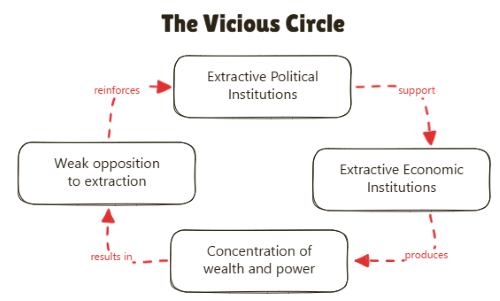
Extractive political institutions lead to extractive economic institutions, which enrich a few at the expense of many. Those who benefit from extractive institutions thus have the resources to build their (private) armies and mercenaries, to buy their judges, and to rig their elections in order to remain in power. They also have every interest in defending the system.
— Acemoglu and Robinson in Why Nations Fail
Example: The Habsburg Empire
At the time of the Industrial Revolution, the Austro-Hungarian (Habsburg) Empire was the third-largest state in Europe. The economic system was a feudal one. The ruler, Francis I, was a strong absolutist who refused to recognise any limitations on his power. There were many monopolies and other trade restrictions, such as very high tariffs on imports and many explicit controls on cross-border and even internal trade.
Francis I was fiercely opposed to any sort of change, including the development of industry. He was concerned that factories would concentrate poor workers in cities, which would undermine the feudal order, and those workers might also organise to oppose absolutism. In 1802, he directly banned the creation of new factories in Vienna.
Many extractive institutions that were set up during countries’ colonial periods persisted after independence. Robert Michels, a German sociologist, coined the phrase the iron law of oligarchy to describe how new leaders will often overthrow old ones with promises of radical change, but then end up recreating (and perhaps even intensifying) the extractive institutions for their own benefit.
History is not predetermined
The virtuous and vicious circles means it is hard for gradual changes to shift institutions. But, throughout history, critical junctures arise where existing institutions can be disrupted.
Critical junctures
A critical juncture occurs when a major event or confluence of factors disrupts the existing balance of political or economic power. Change in both directions is possible — extractive institutions can become inclusive, or vice versa.
Example: China’s economic liberalisation without political liberalisation
The first chairman of the Chinese Communist Party (CCP), Mao Zedong, presided over deeply extractive political and economic institutions from 1949 until his death in 1976.
Mao’s death formed a critical juncture. A power struggle emerged between Hua Guofeng, who wanted to continue Mao’s policies, and Deng Xiaoping, who wanted to move towards more inclusive economic institutions (but without inclusive political institutions).
Deng Xiaoping ultimately won the power struggle and implemented a bunch of liberalising economic reforms. The CCP increased the scope for private ownership, relaxed agricultural price controls, and bolstered the role of market forces and incentives. China also began opening up to foreign investment and trade. All of this led to a dramatic increase in economic growth and productivity.
There was nothing inevitable about any of this. Rather, the outcome was highly contingent, as Deng could well have lost the power struggle.
Both the beginning and end of colonisation are critical junctures for most societies. In most cases in sub-Saharan Africa and much of Asia, post-independence governments simply repeated (and even intensified) the extractive institutions under colonialism. Botswana provides a positive example where inclusive institutions prevailed after colonisation.
Example: Botswana avoiding extractive institutions
Pre-colonial Tswana states in the 1800s had unusually centralised government combined with some form of collective decision-making, where the people had the power to remove bad rulers.
In 1895, three Tswana chiefs travelled to London to petition Queen Victoria to take greater control of their land, to protect it from Cecil Rhodes. The Queen agreed — Britain took nominal control but largely left Botswana alone, which meant Botswana avoided the brutal extractive institutions elsewhere in Africa. After Botswana gained independence in 1966, the government created genuine democracy with competitive elections and enforced property rights, with an inclusive market economy.
Botswana also managed to avoid the resource curse thanks to its inclusive institutions. During the colonial period, the Tswana chiefs had blocked mineral prospecting because they knew that they’d lose their autonomy if the Europeans found precious metals or stones on their land. So diamonds weren’t discovered until the 1970s, after Botswana had already gained independence.
Moreover, before President Seretse Khama announced major diamond finds on his own tribe’s land, he passed a law vesting all subsoil mineral rights in the nation, instead of to individual tribes. This enabled diamond revenues to fund schools, roads, and government services. As a result, Botswana has never had a civil war, and today has sub-Saharan Africa’s highest income per person.
Example: Development of long-distance trade
The development of long-distance trade was a critical juncture for many countries.
In England, the Crown at the time was relatively weak. Trading and colonial opportunities were pretty widely available, and long-distance trade empowered groups opposed to the monarchy, such as merchants. They then used their power to demand political rights. Existing pluralistic tendencies strengthened.
In France and Spain, overseas trade was already monopolised by the Crown. So the monarchy and its allies were the main beneficiaries when Atlantic trade and colonial expansion made much larger profits possible.
In Kongo (now the Democratic Republic of Congo), the kingdom was absolutist, with extractive institutions that captured all agricultural output from citizens. When the Portuguese arrived offering trade, this just intensified the extraction. The kingdom moved from seizing crops to enslaving people, selling them to European traders.
Institutional drift
Two similar societies that start out with only minor differences can drift greatly over the course of centuries. These cumulative differences can also become decisive during a critical juncture and can cause two societies to diverge radically.
Example: The Black Death
In the 1300s, Europe had a highly extractive feudal system. The king owned the land, and distributed some of it to lords in exchange for military service. Peasants who had to work the land were tied to it and couldn’t move without their lord’s permission.
The Black Death in 1347 killed off many people, creating a massive labour shortage. This increased the peasants’ power, and wages began to rise.
At the time of the Black Death, political and economic institutions in Western and Eastern Europe were pretty similar. The lords in the East were slightly better organised and their landholdings were bit more consolidated, while the peasants were slightly less organised. But these small differences were enough to cause great divergence over the coming centuries. By 1600, workers in the West didn’t have to pay feudal dues and were becoming a key part of a market economy, while a Second Serfdom emerged in the East.
How to get inclusive institutions
Broad coalitions with diverse interests
Revolutions or changes supported by broad coalitions tend to lead to pluralistic institutions. When none of the groups in the coalition are strong enough to force a change unilaterally and can only succeed by working together, they have to agree to checks and balances that prevent any single group gaining too much power.
In contrast, conflicts between narrow elite interests tend to simply replace one form of extractive institutions with another. [This made me think of Ezra Klein’s point about the Republican Party’s more homogeneous base making it more vulnerable to polarisation. Perhaps there’s a parallel about how homogeneous coalitions are more easily captured by extractive interests?]
Example: The Glorious Revolution’s broad coalition
The Glorious Revolution of 1688 in England limited the power of the king and opened up the political system to a broad cross-section of society. The coalition opposing absolutism was very broad, including landed gentry, manufacturers, and Atlantic traders.
But broad coalitions do not guarantee inclusive institutions. A similar broad coalition had emerged victorious in the English Civil War (1642-1651), but this just led to Oliver Cromwell’s dictatorship.
Political centralisation
Although the authors repeatedly condemn the concentration of power among a small elite, they acknowledge that some degree of centralisation is needed to maintain order, enforce laws and provide public goods like infrastructure.
One reason why some countries failed to industrialise during the Industrial Revolution was because of insufficient political centralisation. Even today, countries such as Afghanistan, Haiti, Nepal and much of sub-Saharan Africa do not have enough centralisation to provide the order needed for inclusive institutions to arise.
Example: Somalia’s lack of political centralisation
Historically, Somalia has been dominated by six clan families, which are very large with many subgroups. These clans and subgroups have been locked in almost continual conflict over scarce resources.
Political power is very widely dispersed, which made it impossible for Somalia to benefit from the Industrial Revolution. Though clans had leaders (sultans) and elders, they had no real power. There was no written law, police, or functioning legal system.
Foreign aid should be directed at institutions
A lot of foreign aid is wasted, because it fails to address the extractive institutions which lie at the root of poverty. Even making the aid “conditional” on certain reforms does not seem to work, because countries that don’t meet the conditions typically need the aid more than countries that do.
However, this doesn’t mean foreign aid should be cut. It just needs to be redirected to better uses. Since inclusive institutions are key to prosperity, existing foreign aid should be directed to facilitate such institutions. For example, aid could go towards building up broad coalitions that bring groups and leaders that would otherwise be excluded into the decision-making process.
Example: Brazil’s grass-roots movement
In 1964, the Brazilian military overthrew the democratic government. Later, in 1978, news broke that the military government had been distorting the national inflation figures. This riled up a bunch of workers at the Scânia truck factory in São Bernardo, Brazil. Even though strikes had been banned since 1964, the president of the metalworkers’ union, Luiz Inácio Lula da Silva (“Lula”), led a walkout that triggered a wave of other strikes across Brazil.
In 1980, Lula formed a new political party: the Workers’ Party. Despite its name, Lula insisted the party would not just be for trade unionists, but for all wage earners and the poor in general. The Workers’ Party also began to bring together former opposition politicians, intellectuals, and leaders of other social movements.
Throughout the 1980s, the Workers’ Party gradually won local mayoral elections. In 1989, the country held its first free presidential elections since the military coup. Lula did well, but didn’t win. Economic growth picked up in the 1990s. The poverty rate fell from 45% in 1990 to 30% in 2006. Inequality also fell sharply, particularly after the Workers’ Party took power in 2002.
Free media
Free media plays a critical role in keeping institutions accountable and inclusive. It is hard to empower the general population without widespread information about abuses being committed by those in power. The media can also help channel the empowerment of society into political reforms. For example, pamphlets and books played an important role during the Glorious Revolution in England as well as the French Revolution.
Authoritarian regimes are well aware of the critical role played by the media, so they try to control it.
Example: How much is control of the media worth?
Alberto Fujimori’s administration in Peru kept unusually good records of the bribes they paid in order to buy people’s loyalty! The amounts are illuminating. While a Supreme Court judge and other politicians were worth between $5,000 and $10,000 a month, newspapers and TV stations were worth millions.
The Fujimori administration paid $9 million on one occasion and more than $10 million on another to control TV stations. One mainstream newspaper received $1 million, while other newspapers got between $3,000 and $8,000 per headline. Controlling the media was therefore much more important to them than controlling politicians and judges.
My Review of Why Nations Fail
Why Nations Fail has some good ideas, but it’s very long and not particularly well-written. There is a ton of repetition, and many verbose sentences which distract from the core claims.
The authors also state their conclusions in terms that struck me as overly confident, given their framework is loose enough that it can be used to explain almost everything with hindsight. It felt a bit like every time a country failed, they could say the institutions were “not inclusive enough” or “there wasn’t enough centralisation”. And if a country lacked inclusive institutions but nevertheless showed strong growth, they could say “that’s only temporary”. To the authors’ credit, they do acknowledge that their theory has limited predictive power and cannot explain everything. But that humility doesn’t come through in the general tone of the book, where they do try to explain almost everything — even where that means squeezing the facts to fit their narrative.
Although the authors briefly acknowledge that political institutions aren’t limited to written constitutions and whether a society is a democracy, they tend to assume throughout the book that inclusive institutions have to take the form of Western-style democracy and neoliberalism. Yet I find it plausible that political institutions can be somewhat inclusive without Western-style democracy (see Chris Blattman’s comments on polycentricity), and I find it even more plausible that inclusive economic institutions can involve a greater role for the state than the authors seem to envisage. (I plan to expand on these points in a later post.)
Despite these issues, the institutional framework set out in Why Nations Fail is still very valuable. In particular, I think the link between economic and political institutions — and economic and political power — is important and often underappreciated. That seems to be changing, and Acemoglu and Robinson definitely deserve considerable credit for that.
Let me know what you think of my summary of Why Nations Fail in the comments below!
Buy Why Nations Fail at: Amazon <– This is an affiliate link, which means I may earn a small commission if you make a purchase through it. Thanks for supporting the site! 🙂
If you enjoyed this summary of Why Nations Fail, you may also like:
5 thoughts on “Book Summary: Why Nations Fail by Acemoglu and Robinson”
Thanks for the review! The dichotomy of inclusive and extractive institutions makes a lot of sense to me, though I’m still having a tough time parsing economic from political insitutions. For instance, reading the Deng Xiaoping case study makes me think “oh, so it’s implementing inclusive economic institutions that is important”.
Sorry – I only just saw this comment (I didn’t get an email notification). Since A&R see political and economic institutions as being closely interlinked, they don’t really split them up cleanly – so it makes sense you’d have trouble parsing economic from political institutions. I also think their definitions of “inclusive” or “extractive” institutions are a bit slippery, and am working on a post that talks about this (and a few other issues).
Thanks, excellent summary and review
Thank you! And thanks for reading! 🙂
Fantastic summary and more relevant than ever