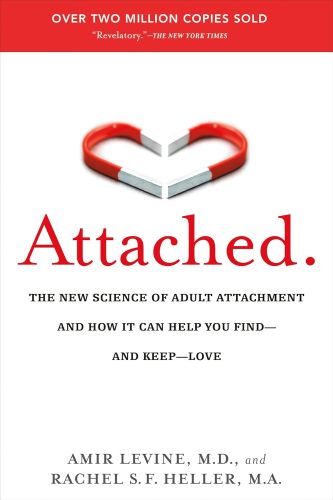
Attached by Amir Levine and Rachel Heller explains how our different attachment styles affect how we approach our romantic relationships.
[Estimated reading time: 21 mins]
Buy Attached at Amazon (affiliate link)
Key Takeaways from Attached
- Attachment theory describes 3 attachment styles in romantic relationships:
- Secure (over 50% of people) describes those who are comfortable with intimacy.
- Anxious (~20%) describes those who crave intimacy but are very afraid of rejection.
- Avoidant (~25%) describes those who are afraid of intimacy and see it as a loss of their independence.
- Much popular dating advice is harmful.
- A lot of advice says that dependency is bad and that happiness should come from within. But dependency is a simple fact — as social creatures, we depend on others for our well-being.
- There’s actually a dependency paradox, in that people who are effectively dependent on one another gain more confidence and security to become more independent.
- Don’t play games — pretending to be more self-sufficient than you are just makes it harder to find someone who can meet your intimacy needs.
- Anxious and avoidant people often date each other. This can be a very destructive pairing, which the authors call the anxious-avoidant trap:
- Anxious and avoidant people are more likely to find each other because: secures don’t tend to stay in the dating pool very long; anxious people are likely to initially find secure people boring; and two avoidants lack the “glue” needed to stay together.
- It’s a “trap” because the two styles strongly conflict in a self-reinforcing cycle. When anxious people get insecure, they engage in protest behaviour hoping to get reassurance from their partner. But this triggers deactivating strategies in avoidants because they’re afraid of intimacy.
- Attachment styles are not fixed. People can become more secure by:
- Entering a relationship with a secure person.
- Building security within your existing relationship, with tactics like “security priming”.
- Recognise and legitimise your own attachment needs as well as your partners’.
- Practise effective communication — this will help you both with finding a suitable partner and ensuring that your intimacy needs are met.
Detailed Summary of Attached
The three attachment styles
We all have a basic need to form close bonds. The brain has a biological mechanism (the attachment system) responsible for creating and regulating our connection with figures such as our parents and romantic partners. An attachment style describes how people perceive and respond to intimacy in romantic relationships. Many people could enjoy better relationships with some insight into attachment styles, which help us understand and predict others’ behaviour. This is especially so for the anxiously attached, who suffer the consequences of a bad match and an activated attachment system most intensely.
There are three main attachment styles:
Secure people (over 50% of the population) feel comfortable with intimacy, and normally expect their partners to be loving and responsive. They know they deserve love and believe that there are many potential partners out there who could love them, so they don’t get too worried about rejection and perceived slights. If their partner disrespects them, they’ll see that as reflecting on the partner rather than on their own self-worth, and will move on. If their partner hurts them, secure people are usually willing to forgive and extend the benefit of the doubt (though this can cause them to end up in bad relationships occasionally, if they go too far with this.)
Anxious people (around 20%) crave intimacy but lack the skills to communicate their needs effectively and are very sensitive to perceived threats to the intimacy they want. They are often preoccupied with their relationships. When a perceived threat arises, they engage in “protest behaviour” to try and re-establish contact, such as calling or texting excessively, manipulating, trying to make their partner feel jealous, acting hostile, or threatening to leave. But if their partner is sensitive and nurturing enough to calm their fears, anxious people can be very loving and devoted partners.
Avoidant people (around 25%) equate intimacy with a loss of independence and so try to minimise closeness. They feel suffocated when things get too intimate, so they use “deactivating strategies” to maintain some emotional distance. Such strategies include: refusing to commit, not saying “I love you”, focusing on small imperfections in their partner, pining after someone unavailable, or holding out for “the one” who ticks every box on their checklist. But these strategies keep avoidants from having fulfilling relationships. Avoidants score lowest on every measure of closeness in personal relationships and tend to be less satisfied with their relationships. They usually blame these unsatisfying relationships on external circumstances rather than on themselves. Research also shows avoidants tend to be less accurate at perceiving their partners’ thoughts and feelings.
[E]xpecting the worst—which is typical of people with insecure attachment styles—often acts as a self-fulfilling prophecy. If you assume your partner will act hurtfully or reject you, you automatically respond defensively—thus starting a vicious cycle of negativity.
— Levine and Heller in Attached
There are also some people who are both anxious and avoidant, but it’s a small category (~3-5% of the population). The book includes a questionnaire designed to help work out your own and your partners’ attachment styles.
Can our attachment styles change?
Some studies have shown a link between how sensitive mothers were to their children’s needs and the child’s attachment style. But the link is a weak one, which suggests other variables also come into play. Studies are mixed on whether there is a correlation between attachment styles in infancy and in adulthood.
On average, about 70-75% of adults have the same attachment style at different points in their lives. The remaining 25-30% of the population report a change at some point. [No source is given. I suspect this figure is self-reported, but I cannot verify it. In Platonic, Marisa Franco notes that one study found 72% of people had the same attachment style throughout their lives, while another study found only 26% did. Both were small studies, and the enormous range suggests some scepticism of these figures is warranted.]
Change can happen in both directions: secure people can become less secure, and insecure people can become more secure. Researchers think a change occurs when a romantic relationship is so powerful that it causes someone to revise their most basic beliefs about intimacy and relationships.
Popular relationship advice can be harmful
Dependency is not a bad thing
A lot of self-help advice suggests that you shouldn’t depend on anyone for your happiness. Happiness is meant to “come from within”. The codependency movement holds each person responsible for their own well-being, not anyone else’s, and emphasises the importance of boundaries. The ideal relationship is seen as one between two self-sufficient people uniting but maintaining clear boundaries. We should bear in mind that the codependency movement’s advice started out in the context of dealing with family members with substance abuse issues. Such advice is invaluable there, but damaging when applied to other relationships.
Many studies show that when two people form an intimate relationship, their biology changes. They regulate each other’s blood pressure, heart rate, breathing, and hormone levels. For example, one study found that when if people were in a satisfying marriage and had high blood pressure, their blood pressure dropped when in their partners’ presence. But for those in unhappy marriages, the partner’s presence actually raised their blood pressure!
In a true partnership, both partners view it as their responsibility to ensure the other’s emotional well-being.
— Levine and Heller in Attached
So dependency is simply a fact, not a choice. It seems that human couples becoming a single physiological unit and regulating each other had strong survival advantages over those who remained independent. Our need for someone to share our lives with has nothing to do with how much we love ourselves
The dependency paradox
In fact, the more effectively dependent people are on one another, the more independent they become.
It turns out that the ability to step into the world on our own often stems from the knowledge that there is someone beside us whom we can count on—this is the “dependency paradox”.
— Levine and Heller in Attached
Most people are only as needy as their unmet needs. When emotional needs are met and they feel secure, they gain confidence and can turn their attention to other things.
Don’t play games
Many popular relationship books advise people not to make themselves too available and to act like they’re busier than they really are. But this just means you’re waving aside your actual needs and feelings and pretending to be more self-sufficient than you truly are. In the short-term, this will make you more attractive to avoidant people. In the longer-term, it makes it harder to achieve true intimacy. If your partner is avoidant, once you finally let down your guard and let them how much closeness you actually want, they may get cold feet and disengage.
The anxious-avoidant trap
Relationships between the anxiously attached and the avoidantly attached are often challenging because one partner truly wants intimacy but the other feels very uncomfortable with it.
This mismatch of intimacy needs can spill over into many interactions and domains. Seemingly trivial things like one partner wanting to hold hands more often than the other can become large, heated fights as the differences reflect a deeper underlying mismatch, and each partner exacerbates the other’s fears and insecurities.
Why anxious and avoidant people are likely to date each other
Anxious-avoidant pairings are very common (especially anxious women coupled with avoidant men) because:
- Secure people usually don’t go through many partners before they settle down. Avoidants, by contrast, tend to end their relationships more frequently and “get over” their partners quicker. So avoidants tend to be in the dating pool longer.
- Research has shown that avoidants hardly ever date one another, because they lack the relationship “glue” that keeps people together. Also, many avoidants feel independent and powerful when their partner is needy and incapable, so two avoidants are unlikely to date each other.
- One study found that avoidant people prefer to date anxiously attached people.
- Many anxiously attached people find the suspense involved with dating an avoidant exciting. They learn to equate the anxiety and obsession that come with their activated attachment system with love and passion. By contrast, when they date a secure person who communicates in a straightforward, honest way, their attachment system remains calm — and that feels boring.
The two attachment styles complement each other in a way. The relationship confirms the avoidant’s beliefs that others want more closeness than they are comfortable with, and that they are strong and independent. It simultaneously confirms the anxious person’s belief that they want more intimacy than their partner can provide. However, anxious and avoidant people can bring out the worst in each other.
The self-reinforcing cycle
A relationship between an anxious and an avoidant may start out reasonably well, as the avoidant is not yet threatened by the level of intimacy. But once the anxious person becomes the closest person to the avoidant, the avoidant may start to treat them worse.
Anxious people are very sensitive to possible threats to their relationship and can pick up on subtle cues. So something will eventually activate the anxious person’s attachment system and alert them that their relationship is in danger. They’ll then look for some sign from their partner to assure them their relationship is safe. If they don’t get that reassurance, their fears may balloon, and they start engaging in protest behaviour.
Protest behaviour is any behaviour that tries to re-establish contact with one’s partner and get their attention. It may include calling or texting many times, withdrawing, keeping score, acting hostile, rolling eyes, pretending to be busy, trying to make the partner jealous, threatening to leave, and so on. Such behaviour is harmful to the relationship. In response to such behaviour, the avoidant withdraws and employs deactivating strategies.
Conflicts are rarely satisfactorily resolved, as that requires each party to be open about their intimacy needs and emotions. That is too much closeness for an avoidant. Typically, the anxious partner ends up making concessions and settling for the level of intimacy the avoidant partner wants. This often happens because the anxious partner gets overwhelmed by negative emotions and acts in extreme ways when they feel hurt. So with every fight, the anxious person loses ground, and has to settle for the initial, unsatisfactory level of intimacy — or even less.
Many people who live in an avoidant-anxious trap have a hard time admitting to themselves and others that they are in a bad predicament. They’ll admit that they’re not completely satisfied with their relationship, then will qualify it by saying, “But who is?
— Levine and Heller in Attached
The relationship can go on like this for a long time. Every once in a while, the avoidant partner may make themself available to the anxious partner, leading the anxious partner to feel a “high.” But since the avoidant partner sees this closeness as a threat, they’ll likely withdraw again soon after. As such, the relationship can feel a bit like a rollercoaster.
How to become more secure
Partnering with a secure person
Research shows, unsurprisingly, that couples where both partners are secure tend to be happier and function better than couples where both partners are either anxious or avoidant. But what was surprising was that “mixed” couples (where only one partner was secure) seemed to function just as well as couples with two secure partners. This suggests that a secure person can nurture their partner to a more secure stance. And, luckily, the majority of the population (of all genders) is secure.
Secure people tend to be good communicators — they are willing to discuss their emotions openly, and are less likely to play games. Those who have only had insecure partners are often surprised by how different it can feel to be with someone secure. Some initially find it boring. Secure people don’t do the “relationship dance” where, as one partner tries to get closer, the other steps back to maintain the same level of distance in the relationship. But secure people make great partners, as they naturally know how to soothe their partners and take care of them. So don’t make impulsive decisions about whether someone is right for you based on how activated or excited your attachment system feels at the start , and give it some time. This may feel challenging for anxious people, who tend to get attached very quickly.
Building security
If neither you nor your partner are securely attached, there are still ways you can build towards greater security in your relationship.
One tactic is security priming. Think of security-enhancing experiences you’ve had or how a secure role model might behave in a similar situation. What would that secure person choose to ignore? How would they behave when their partner is feeling down? Studies have found that this alone can help people feel more secure and subsequently adopt more secure behaviours.
You may even think about your attitude towards your pets (if you have any). If your pet does something to hurt or inconvenience you, you don’t assume they’re doing it intentionally. You probably won’t hold a grudge against them, and you’ll still greet them warmly after a rough day at work. Try to tap into that as a source of security.
It also helps to just have fun together as a couple, doing things you both enjoy. These activities can give us oxytocin boosts, which make us more agreeable and less vulnerable to conflict. Avoidants in particular find it easier to let down their guard and get closer to their partner if there’s something else they can focus on.
Recognise and legitimise needs
We all have specific needs in relationships, and many of those needs will depend on your attachment style. One person might have a strong need for closeness and a lot of reassurance that their partner loves and respects them. Another person may genuinely want less intimacy and need a certain amount of distance (whether physical or emotional), no matter who they are with. Neither person’s needs are “good” or “bad” — they just are what they are.
…[I]n fact, people have very different capacities for intimacy. And when one person’s need for closeness is met with another person’s need for independence and distance, a lot of unhappiness ensues.
— Levine and Heller in Attached
To find a partner who can fulfil your intimacy and availability needs, you first need to fully acknowledge those needs and understand that they are legitimate. If you’re anxiously attached, you shouldn’t let others make you feel guilty for being “needy” or “dependent”. Nor should you try to deny your needs to please your partner. If you’re avoidantly attached, you shouldn’t assume that your need for space means you feel less attraction to your partner. It may just be a personal need, independent of your partner. Ultimately you must ask yourself if you and your partner can meet each other’s needs, so that both are happy.
Even if your intimacy needs don’t perfectly align with your partner’s, you may be able to work out a practical compromise that keeps both of you happy, as in the example below. But this won’t always work — repeated and sincere efforts to find a compromise can still fail.
Example: Georgia and Henry
Georgia (anxiously attached) would often call her partner Henry (avoidantly attached) at work and leave him a message, but he’d rarely get back to her. From Henry’s POV, he was busy at work with patients and would get frustrated by Georgia’s calls and texts. When he did eventually get back to her, the conversation would start off on a bad, annoyed note.
After Georgia and Henry gained an understanding of their different attachment styles, they learned to see the other’s perspective. Henry realised that by ignoring his wife’s needs and ridiculing her dependency, he was only making things worse. Georgia realised that her behaviour was driving Henry away instead of making him want to be there for her.
They managed to work out a mutual solution — Henry would send Georgia a prewritten text message whenever he thought about her. This solution greatly reduced Georgia’s anxiety and worked wonders for their relationship.
Effective communication
The first way effective communication is useful is by helping you choose the right partner. Anxious people who need a lot of reassurance often hide it so they don’t come off as “needy”. Yet by stating your needs directly and unapologetically, you’ll probably come off as self-confident and assertive, not needy. It’s far better than protest behaviour. Since most people react negatively to protest behaviour, you won’t know if their reaction is to the behaviour or to your needs.
Expressing your needs clearly is also one of the best ways to discover your partner’s attachment style. Once your partner sees you be so open, they’re likely to follow suit. Your date’s response to effective communication can reveal more in 5 minutes than in months of dating without it.
Example: Jena being upfront about her needs
Jena really wanted to get married and have children, but for years, she wouldn’t be upfront about this with the guys she dated because she didn’t want to sound “desperate”. But after she turned 40, she couldn’t afford to waste any more time. She started telling men on her first dates that she wanted to be a mother, and was only interested in dating men who wanted to have kids ASAP.
While Jena’s directness did scare off a few guys, she ended up meeting Nate, who wanted exactly the same thing and found it refreshing that she wasn’t afraid to say exactly what she wanted. Today, Jena and Nate are the happy parents of two kids.
Effective communication also helps ensure your intimacy needs are met. Even with a suitable partner, this won’t automatically unless you communicate your needs clearly. While there is always a risk that the other person reacts negatively to your needs, effective communication can bring a lot of relief by confirming how much your partner loves you.
Even when your partner’s response is not what you’d hoped for, the authors have never heard anyone say they regretted raising an important issue in a relationship. All couples fight and have conflicts, but well-managed conflict can be an opportunity for couples to get closer. Using effective communication means you don’t put your partner on the spot or accuse them, and you don’t get defensive about your needs either. The fundamental premise of a good relationship is that your partner’s well-being is as important as your own.
[The book has some more specific advice here, with things like “5 Principles of Effective Communication”. But I would recommend Difficult Conversations instead, which covers a lot of the same ideas much more thoroughly.]]
[I]neffective communication can be interpreted in different ways while effective communication has only one specific meaning. That’s why your partner’s response to effective communication is much more telling than their response to ineffective communication or protest behavior.
— Levine and Heller in Attached
My Review of Attached
Attached is a pretty short and easy read, with many examples throughout to pad it out. I can see how this book could be very useful for some people, but I was left rather disappointed. After first reading about attachment styles in Platonic (in the context of friendships) and finding it eye-opening there, I thought I’d check out Attached to learn more. Unfortunately, I didn’t really learn much more.
The book seems to be aimed mostly at the anxiously attached. The authors were far more sympathetic to them than to avoidants. For example, they focus a lot on how avoidants’ lack of reassurance and withdrawal can hurt anxious people, but completely skip over how anxious people’s protest behaviour can hurt others. Although they do denounce protest behaviour, they focus on how the behaviour hurts the anxious person (by causing them to lose ground in each fight), rather than their partner. There were quite a few times I thought they made avoidants sound like complete assholes. (Platonic was far more even-handed about this.)
I also think there is a difference between a person’s intimacy style/preferences and how they actually behave. Attached flattened this distinction, often describing avoidants in rather “fixed” ways. In contrast, Marisa Franco explains in Platonic that most people have a primary attachment style but still show patterns of other styles. That rang true for me — I think I have grown much more secure over the years and have learned a lot of effective communication skills. But I definitely started out as an avoidant and can fall back into those patterns when stressed.
Lastly, I was very disappointed in the quality of research cited in this book. The subtitle reads: “The New Science of Adult Attachment”, and the cover lists Levine and Heller’s M.D. and M.A. qualifications. But the book often referred to research findings without clearly indicating the source or explaining how the study was carried out. Many claims — such as over 50% of people are secure, and about 25-30% of people change their attachment style during their lives — are made with no citation at all. I am pretty sceptical of these claims and suspect they rely heavily on self-reporting — but I have no way to check if that is true.
Anyway, to summarise: possibly worth reading for anxiously attached people, particularly those who don’t yet feel secure in their relationship. But I wouldn’t bother if that’s not you.
Let me know what you think of my summary of Attached in the comments below!
Buy Attached at: Amazon <– This is an affiliate link, which means I may earn a small commission if you make a purchase through it. Thanks for supporting the site! 🙂
If you enjoyed this summary of Attached, you may also like: