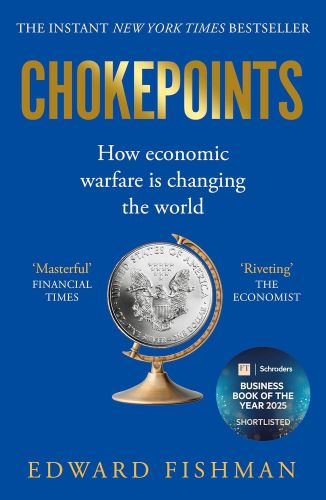
This summary of Chokepoints: American Power in the Age of Economic Warfare explains how the US started using its financial and technological power to achieve foreign policy goals. While it doesn’t discuss the use of physical chokepoints like the current Strait of Hormuz blockade, Fishman gives us rich insight into how economic warfare decisions (including those that led to the 2015 Iran nuclear deal) were made.
[Estimated reading time: 24 mins]
Buy Chokepoints at Amazon (affiliate link)
Key Takeaways from Chokepoints
- Economic war has become a meaningful alternative to military war:
- After very costly wars in Iraq and Afghanistan, the US grew reluctant to use military power to achieve their foreign policy ends.
- Around the same time, globalisation has increased the US’s control over financial and technological chokepoints.
- Sanctions serve two different purposes, and the purpose can shift over time:
- Deterrence. Sanctions threats need to be credible if your aim is to change an adversary’s behaviour. You also need to design off-ramps to lift the sanctions if the desired change occurs.
- Weakening an adversary. Here, the damage done by the sanctions is the whole point.
- There are many factors to consider when deciding how to use sanctions:
- Asymmetrical costs. Sanctions come with economic costs, especially if they affect oil prices (Iran, Russia) or the global economy (China). The key is to look for areas where sanctions cause much more harm to your adversary than to yourself.
- Unilateral vs coordinated. Unilateral sanctions risk alienating allies and can be difficult to enforce, while coordinated sanctions take longer to get agreement on, and can get watered-down in negotiations.
- Enforcement. Sanctions only work if businesses comply. But sometimes businesses “overcomply”, which can undermine the effectiveness of sanctions.
- Who benefits from freezing the status quo. One reason why sanctions successfully deterred Iran but failed to deter Russia may be because freezing the status quo hurt Iran, but benefited Russia.
- Overuse or underuse. Reckless or excessive use of sanctions can reduce their power over time, as countries find ways to protect themselves. But too much caution can be just as big a risk.
- Going forward, Fishman expects economic weapons will continue to be used.
- The US should take a more proactive approach, such as setting up a permanent economic war council and coordinating with allies regularly.
- Sanctions could be more effective if the public better understands why they are needed and public acceptance grows.
- As countries act to protect themselves against future sanctions, the world may increasingly fragment into rival economic blocs.
Detailed Summary of Chokepoints
Economic war as an alternative to military war
Before the 2000s, economic wars were generally unsuccessful. Imposing serious economic pressure required a lot of naval power, a broad international coalition, or both. This was hard to muster up, especially during peacetime. After two very costly wars in Afghanistan and Iraq, the US grew more reluctant to resort to military power to achieve its foreign policy goals.
Policymakers like economic weapons because they are non-violent. Especially when acting against a nuclear power, economic weapons are less likely to escalate into a nuclear war. They also don’t require the UN’s backing, so can be used against Russia and China (who sit on the UN Security Council). (That said, UN resolutions are still helpful, as they give sanctions an air of legitimacy.)
For a long time, most people in US foreign policy saw sanctions as a symbolic gesture — something more severe than a strongly worded statement, but not a serious alternative to war. This started to change beginning in the 2000s, and particularly after the Iran nuclear deal in 2015.
Financial chokepoints
Since the end of the Cold War, globalisation has made financial sanctions more powerful than ever. Many of the institutions that facilitate cross-border trade are either American, or have significant US operations. For example, if an Indian refinery imports oil from Saudi Arabia, it likely has to send a wire transfer through a major New York bank. The wire is then cleared through one of two US-based payments systems (the Clearing House Interbank Payments System (CHIPS) or the Fedwire system).
The SWIFT distraction
SWIFT is basically an international messaging service for banks, based in Brussels. After Russia invaded Ukraine in 2022, there was a lot of public and political attention focused on whether Russia should be banned from SWIFT. This was misguided — journalists and lawmakers had given SWIFT too much credit for isolating Iran back in 2012.
When Iran got cut off from the global financial system, it wasn’t because of the SWIFT ban but because of blocking sanctions on its banks, which effectively forced international banks to choose between doing business with Iran or doing business with the US. Moreover, Russia had built its own alternative (SPFS) after 2014, so access to SWIFT was convenient, but not indispensable.
The USD is another important financial chokepoint. Most banks only hold significant stocks of two currencies: their domestic currency and the USD. If Saudi Arabia wants to buy Indian rice, a Saudi bank must first convert riyals to USD and then use that USD to buy rupees. Although the US itself accounts for less than 10% of global exports, around 90% of foreign trade involves USD.
… [T]rying to navigate the global economy without access to the dollar is like trying to travel the world without a passport.
— Edward Fishman in Chokepoints
Technological chokepoints
The US also dominates key technological chokepoints, particularly in semiconductors. Although chips are manufactured around the world, almost all rely on US-designed software, equipment, or intellectual property.
Example: US sanctions against Huawei
By the late 2010s, Huawei had become the global leader in 5G equipment, with best-in-class technology priced 30% below its competitors. As other countries (including allies like the UK) announced partnerships that allowed Huawei to build out their 5G networks, the US grew alarmed. They were worried that Huawei had embedded secret backdoors or kill switches into its equipment, even though the UK believed it could manage those risks.
Initially, in 2019, the US added Huawei to its Entity List, which cut it off from US suppliers. But those rules were full of loopholes, so didn’t affect Huawei too much. The US then followed up in May 2020 with its Foreign Direct Product Rule (FDPR). The FDPR banned all sales of chips made using US technology to Huawei, regardless of where in the world those sales took place. The most important target was TSMC, the Taiwanese chipmaker that produced almost all of Huawei’s most advanced chips. At the time Huawei was TSMC’s second-biggest customer, accounting for over 15% of its revenue. But TSMC’s US connections mattered more, so it cut ties with Huawei.
The effects were dramatic. The UK banned Huawei, as Huawei admitted it would be months before they could even explain how the FDPR would affect its deliveries. Doing so cost the UK £2 billion and set back its 5G rollout by up to 3 years. Other countries soon followed. In the first half of 2021, Huawei’s revenue plummeted by nearly 30%.
Example: The US could set global standards for AI
Fishman suggests the US could also use its technological chokepoints to set global standards for the responsible use of AI going forward. More than 70% of AI chips sold worldwide are designed by Nvidia, a US company. The US could simply ban Nvidia and other US tech firms from transacting with anyone that refuses to adopt its standards.
Sanctions can serve different purposes
Deter
Sanction threats need to be credible in order to deter behaviour. At the same time, if adversaries know how far you’re prepared to go, they can plan around your sanctions.
Example: Sanctions against Russia’s central bank
While Joe Biden and several European leaders warned Russia that invading Ukraine would incur the “most severe sanctions that have ever been imposed”, Putin invaded anyway. After the invasion, the G7 countries sanctioned Russia’s central bank. This was a big deal.
At the time, Russia’s central bank had more than $630 billion in foreign exchange reserves, which it had planned to use to prop up the rouble and protect its economy, as it had done after the West sanctioned it in 2014 for annexing Crimea. More than half of these reserves were held in G7 currencies in Western financial institutions, which suggests Putin had never expected the West would go after his central bank. (To be fair to Putin, the US and Europe hadn’t worked out what sanctions they’d be willing to impose before the invasion, either.)
This suggests Russia underestimated the severity of the sanctions it would face, which means the central bank sanctions could not act as a deterrent. But if Russia had expected central bank sanctions, it wouldn’t have left itself so exposed to them, either.
If you’re using sanctions to try and change another country’s behaviour, you also need to design off-ramps to lift the sanctions if the desired change happens.
Example: Iran nuclear deal
By 2012, the US and EU had imposed secondary sanctions on banks and energy companies doing business with Iran, and had also sanctioned its central bank. The economic effects were severe: Iran’s currency fell by 50% against the USD in the first 8 months of 2012, inflation soared above 30%, and protests erupted in Tehran’s Grand Bazaar.
Since the point of the sanctions was to deter Iran’s nuclear ambitions, they were designed to be lifted if Iran stopped pursuing its nuclear programme. When an interim deal was reached in 2013, the US unfroze $4.2 billion of Iran’s assets. This was less than 2 months of oil revenues, but enough to keep Iran at the negotiating table. After the full deal (the JCPOA) was concluded in July 2015, and the International Atomic Energy Agency (IAEA) confirmed that Iran was abiding by its commitments, the US removed more sanctions.
Weaken
Here, the damage done by the sanctions is the point. However, once you use sanctions for this, they can no longer deter.
Example: Weakening vs deterring Russia
Western sanctions against Russia were initially aimed at deterring it from invading Ukraine. But after deterrence failed, the purpose shifted to weakening Russia more generally.
Fishman raises the possibility that, if economic sanctions could never have deterred Putin anyway, maybe it would’ve been better to weaken Russia’s economy as much as possible before the invasion. Perhaps the G7 should have sanctioned Russia’s oil and central bank much earlier. [This seems very risky though. Fishman himself flags the “security dilemma” later on, and pre-emptive economic strikes seem to raise the similar concerns as pre-emptive military ones.]
Example: US sanctions on China
Unlike with Iran and Russia, where the goal was to change a specific behaviour, the Trump administration’s sanctions against China were aimed at downsizing China’s role in the world economy.
This was not a particularly coherent strategy, as different camps within the Trump administration held different views:
- Robert Lighthizer and Peter Navarro (on the trade side) wanted a dramatic break in economic relations. Steve Bannon (Trump’s chief strategist) was a major China hawk, and even considered joining forces with Russia to take on China.
- Steven Mnuchin and Gary Cohn (Treasury side) were both Goldman Sachs veterans who believed in free markets and didn’t want an economic decoupling. So even though Treasury had pioneered the use of economic weapons, it stayed on the sidelines with China and the Commerce Department played a bigger role instead.
- Trump was very trigger-happy with sanctions, but didn’t care that much about national security or technological competition. Rather, he just wanted to get a big trade deal with China and close the US’s bilateral trade deficit. As such, he was repeatedly willing to reverse measures to try and get a deal.
“Decoupling from China” became an implicit goal by default, without a lot of consideration for what this would really mean. Taken to its logical conclusion, it implies the world would be split into rival blocs, undermining the very globalisation that had given the US its economic weapons in the first place.
The penalties were not designed to change behavior but to downsize China’s role in the world economy. Over time, inflicting economic damage on China became an end in and of itself.
— Edward Fishman in Chokepoints
When Biden came to office, he ordered a top-to-bottom review of Trump’s sanctions, as liberal use of them had damaged the US’s standing in the world. However, China was the one area where Biden kept and even tightened Trump’s sanctions.
Factors to consider when using sanctions
Asymmetrical costs
Sanctions come with economic costs, especially when imposed against countries that can affect oil prices (Russia) or large countries with which you have many economic ties (China). Globalisation has simultaneously increased both the power of the US’s economic chokepoints and the costs of using those chokepoints.
The key is to look for areas where sanctions have asymmetrical costs, and can be applied “surgically”.
Example: Targeting Russia’s capital markets
After Russia annexed Crimea in 2014, the US wanted to sanction Russia. However, they’d never sanctioned an economy as large and integrated with world markets as Russia’s before. Russia was also a much larger oil and gas producer than Iran, and Europe was heavily dependent on Russian energy. So officials studied Russian banks and companies to identify potential sanctions targets.
Their work resembled intelligence analysis, but instead of relying on spy reports and intercepts, they used Bloomberg terminals, corporate filings, and financial statements.
— Edward Fishman in Chokepoints
They then applied a set of “sectoral sanctions” that restricted Russian banks and energy firms from raising debt in Western capital markets. They also banned sales of oil-related equipment and related services to Russia. This wouldn’t disrupt the flow of Russia’s existing oil, but would prevent Russia from developing new oil projects in the Arctic and in shale formations.
Combined with the 2014-15 collapse in oil prices, the sanctions were enough to push Russia into recession. Meanwhile, the costs to the US and Europe were minimal — some oil companies were unhappy, and US asset managers and industry lobbyists were unhappy, but oil prices didn’t spike.
Unilateral vs coordinated
Unilateral sanctions risk alienating allies and can be ineffective if other countries just bypass them. Yet getting agreement on coordinated sanctions can take a long time and result in watered-down sanctions.
Example: Secondary sanctions on Iran — first attempt
When Iran resumed its nuclear programme in the 1990s, the US tried to impose economic sanctions on it. However, since Iran-US trade was already low, direct sanctions had little effect.
The US therefore tried to impose secondary sanctions on foreign companies doing business with Iran under the 1996 Iran and Libya Sanctions Act (ILSA). For example, when Total (a French energy company) announced plans to develop Iran’s natural gas field, this should have triggered US sanctions on Total.
This didn’t sit well with Europe, who wanted access to Iran’s energy and hadn’t been involved in the design of the sanctions. As a result, the US reached a compromise whereby it wouldn’t penalise European firms if Europe agreed to “cooperate” with the US on Iran. What “cooperate” meant was unclear, but the upshot was that secondary sanctions under ILSA were never actually used.
The US’s second attempt to impose secondary sanctions was more successful.
Example: Secondary sanctions on Iran — second attempt
In 2011-2012, the US wanted to put secondary sanctions on anyone who traded with Iran’s central bank. However, none of Iran’s major customers (China, India, Japan, South Korea, or Türkiye) were prepared to impose embargoes.
Technocrats at Treasury came up with a plan to waive sanctions for any country that significantly reduced its oil purchases from Iran over a 6-month period. The idea was that the policy would reduce Iran’s oil exports gradually, which would mitigate the economic harm.
To get China and India on board, the US pointed out that overreliance on Iranian oil could be a vulnerability and promised to help them identify alternative suppliers, such as Iraq. Though neither China nor India publicly admitted to complying with US sanctions, diplomacy seemed to work — both countries decided to reduce oil purchases from Iran for “energy security” reasons.
By the time the US sanctioned Russia, Europe was consulted rather than informed.
Enforcement
Passing a new sanctions law does not guarantee that businesses will comply. They will only do so if they believe the costs of violating the sanctions outweigh the benefits. However, “overcompliance” can also be a problem — if businesses are scared off trading with a country, that can make it difficult to “unwind” sanctions once a deal is reached.
Example: Providing relief under the Iran nuclear deal
Stuart Levey, the US Treasury’s first undersecretary for terrorism and financial intelligence, understood that large financial institutions are highly risk averse. He went directly to major international banks and showed them evidence that Iran had illegally falsified financial transaction data to fund its nuclear and terrorist programmes. If banks facilitated these transactions, even if they did so unknowingly, they could be severely fined by the US.
Within 18 months, virtually all major international banks stopped dealing with Iran, even though their home governments had not legally required this. It was just too big a regulatory and reputational risk.
But even after the Iran nuclear deal (the JCPOA) came into force, banks were reluctant to re-enter Iran. They had learned over years that doing business with Iran was not worth the risk, even if the US Treasury assured them it was fine. Moreover, it was the US Justice Department that issued fines, and some companies still got sanctioned for breaching sanctions that hadn’t been lifted.
Iranian diplomats frequently complained about this, and US officials saw it as a real problem. If the deal failed to deliver for Iran, hardliners in Iran who had argued against the deal would be vindicated, and the deal could fall apart.
Who benefits from the status quo
When sanctions are used to deter behaviour, you must consider who will be advantaged or disadvantaged by the status quo. One of the reasons why Fishman believes the Iran sanctions worked while the Russian sanctions failed is that the status quo benefited Russia.
Example: Status quo in Iran vs Russia
With Iran, the country didn’t have nuclear weapons, so freezing the status quo benefited the US. After the sanctions were imposed, Iran’s economy just weakened as time passed, without getting any closer to acquiring nuclear weapons.
With Russia, however, a freeze benefited Russia. Russia had already annexed Crimea in 2014 and controlled the territory on the ground. As time passed, their control over Crimea and the Donbas merely ossified.
Moreover, as time passed, US domestic politics could prompt a change in the US’s stance towards Russia. During the 2016 US presidential campaign, Trump had said that if he were president, the US would have “a great relationship with Putin and Russia” and several of his aides had close links to Putin. Delay therefore allowed Russia to hold out for a more sympathetic US administration.
Overuse or underuse
If sanctions are used recklessly or excessively, they may lose their power as adversaries learn to reduce their dependence on you. For example, Russia and China have both tried to launch alternative intermediaries and payment systems (though these haven’t gained much traction) and Russia has found ways to export oil without relying on Western shipping and insurance, such as through a pipeline to China. China has also worked on building up its domestic chip manufacturing technology, though they are still at least 5 years behind the leading chip manufacturers (and even further behind other equipment makers).
Sanctions are like antibiotics: they work well when used correctly but cause a host of problems when used excessively or inappropriately. In some cases, they’re simply the wrong approach …
— Edward Fishman in Chokepoints
However, while some US officials see overuse of sanctions as the biggest risk, Fishman argues underuse can be just as dangerous. If you use sanctions hard enough to cause economic pain, but not hard enough to change behaviour, you may end up revealing to your adversary exactly where your resolve runs out.
Example: Excessive caution after Russia annexed Crimea
After Russia annexed Crimea in 2014, the US and Europe hesitated to inflict maximum pain on Russia. Obama was cautious by nature, and he was influenced heavily by Angela Merkel, who opposed sending anti-tank missiles to Ukraine.
Germany (Merkel) and France (François Hollande) had been spooked by how badly Russia’s economy had deteriorated, and feared it would spill over into their own economies. They pushed vigorously for a peace deal, and negotiated an agreement (Minsk II) under which Ukraine would give more autonomy to Donetsk and Luhansk in exchange for control over them.
Not only did this stop the US and Europe from arming Ukraine, it also undercut momentum for further sanctions. Russia basically ignored Minsk II.
In the end, the West’s caution proved a costly error. It allowed Russia to absorb the initial shock of sanctions and then carry on much as it had before …
And it ultimately reinforced Putin’s view that the West was weak and unwilling to bear the burden of a high-intensity economic standoff
— Edward Fishman in Chokepoints
Economic weapons will continue to be used
The world economy is experiencing what scholars call a “security dilemma”: as one state builds up its economic arsenal to improve its security, others feel less secure and build up their own arsenals in turn.
— Edward Fishman in Chokepoints
Prepare and be proactive
Although the US can inflict a lot of damage with its economic weapons, it’s often done so in a reactive way with little advance planning. Fishman recommends adopting a more proactive strategy and getting other agencies and allies on the same page earlier.
A good start would be to set up a permanent economic war council within the US government to plan the economic wars of the future (e.g. the confrontation with China over Taiwan). The US should also establish regular sanctions-planning dialogues with like-minded countries, so that officials don’t have to build international coalitions from scratch for each new sanctions campaign.
Improve the public acceptance of sanctions
Western leaders struggle to use economic weapons to their full extent when doing so damages their countries’ economies (even if it inflicts much greater damage on their adversaries’ economies). This is especially true when sanctioning oil-producing countries like Russia and Iran risks oil price spikes.
Fishman suggests we need to improve the public’s understanding of sanctions and why they may be needed. Despite all the downsides of economic war, the idea is that it can be an alternative to a more violent, military war. Reducing domestic oil consumption would also reduce the impact of oil price shocks on households and businesses, which would give the US greater latitude to use sanctions effectively.
Increasing fragmentation
As countries act to protect themselves against the possibility of future sanctions, the world may increasingly fragment into rival economic blocs.
It’s not just countries that have been directly affected by Western sanctions that have looked to reduce their dependence on the West. Other countries have been spooked by the fact that the West has sanctioned countries as large as Russia and China. The BRICS alliance has accordingly expanded to 10 members from its initial bloc of 5 (Brazil, Russia, India, China and South Africa), and has grown closer as countries looked for ways to support each other if they are sanctioned.
The trade-offs facing policymakers in Washington, Beijing, Brussels, and Moscow can be thought of as an impossible trinity consisting of economic interdependence, economic security, and geopolitical competition. Any two of these can coexist but not all three.
— Edward Fishman in Chokepoints
Other Interesting Points
- Fishman interviewed more than 100 people for his book, including current and former US and foreign officials, and business executives. In most cases, he confirmed the events he describes with multiple sources. Fishman himself also participated in some of the events directly, as he served at the Treasury in 2011 and at the State Department and Pentagon from 2013 to 2017.
- Politicians vs officials — the book reveals how much work and strategising is done by civil servants, rather than the politicians:
As [Björn Seibert, Head of Cabinet at the European Commission] often told [Daleep Singh, US Deputy National Security Advisor], the best they could do was come to an understanding among policy wonks and have options ready for their bosses when the moment came. The leaders themselves would most likely hedge until confronted with the inescapable, grim spectacle of war: tanks rolling, missiles falling, buildings burning.
— Edward Fishman in Chokepoints
- Oil is priced in dollars because in 1975 (during the 1970s oil crisis) the US had promised to help Saudi Arabia get more voting rights at the IMF if the Saudis and OPEC continued to price oil in dollars.
- Supply-chain professionals have long pushed for more redundancies and resilience to handle unforeseen crises, but the economic incentives to do so had always been lacking. This has started to change, as countries increasingly look to diversify their supply chains.
My Review of Chokepoints
Despite its rather dense subject matter, Chokepoints is well-written and easy to read. Unlike this summary, the book is written in a narrative format, in chronological order. I usually dislike (and distrust) narratives, but Fishman pulls it off pretty well. He clearly knows what he’s talking about, and the narrative format effectively conveys how hard foreign policy can be. It can be tempting to second-guess decisions based on how they turn out, with perfect hindsight. But most of these decisions require managing a variety of difficult trade-offs under tight time constraints, and with only partial information.
One of the book’s strengths is how it highlights the many constraints policymakers face, including internally. People often talk of “the US” or “the government” as if it were a single actor, but Fishman takes us through multiple disagreements between the White House and Congress, and shows how, even within the same administration, the Treasury’s positions may not be aligned with the Commerce or the Justice Departments’. I’m sure the same applies to other governments as well. We see glimpses of this with Iran (when the US withdrew from the Iran nuclear deal, it destroyed the credibility of the pro-diplomacy faction in Iran and empowered hardliners) and a little bit with Europe.
However, sometimes Fishman seems to oversimplify and even mischaracterise other countries’ positions. For example, he paints “Europe” as being complacent and naïve about Russia. While I’m sure there’s some truth to that, I expect the political dynamics within Europe are more complex than Fishman portrays — it consists, after all, of dozens of countries with interests that genuinely diverge. Fishman also confidently repeats the idea that China’s Belt and Road Initiative (BRI) was intended as a “debt trap” for developing countries, even though many studies push back against that narrative and point out that China’s strategy was far more fragmented (and, frankly, incompetent) than BRI critics tend to claim. Of course, we can’t expect anyone to be perfectly unbiased. But Fishman’s writing generally comes off sober and measured, so it can be easy to forget his views will be shaped by his own experiences within the US national security apparatus.
Lastly, although it’s not really the point of the book, I thought Fishman did a nice job of showing how effective policy depends on the hard work of so many unrecognised public servants. For example, the Iran nuclear deal in 2015 took a huge amount of work — the final deal took 18 months to get across the line, and many members of the negotiating team had to spend months away from their families. It certainly makes me highly sceptical of claims that the US could have got a better deal if it had just taken a more aggressive stance. And recent events have only served to reinforce that scepticism.
Let me know what you think of my summary of Chokepoints in the comments below!
Buy Chokepoints at: Amazon <– This is an affiliate link, which means I may earn a small commission if you make a purchase through it. Thanks for supporting the site! 🙂
If you enjoyed this summary of Chokepoints, you may also like:
2 thoughts on “Book Summary: Chokepoints by Edward Fishman”
I’m reminded of the Strait of Hormuz fiasco, how countries overly reliant on global energy trade were badly burnt and reminded of the geopolitical importance of self-reliant energy production. I’m thinking something similarly with sanctions – with enough sanctions thrown around, the natural response becomes self-reliance and building up internal industries. If enough countries do that, then the threat of sanctions inherently becomes less powerful. Maybe in the long run (over many decades), sanctioned countries may end up better off for having that? What do you think there? Did the book explore this?
Oh there’s definitely a parallel there. The book does talk about how, as countries all pursue self-reliance (whether to protect themselves from sanctions or other supply chain risks), the world will increasingly fragment into rival blocs. Fishman says this is the “logical endpoint” of the US’s China policy, and seems to suggest this is something that the US (or at least the first Trump administration) hadn’t fully thought through. He doesn’t indicate whether he thinks this logical endpoint is good or not.
As for myself – I think a globalised world with lots of economic interdependence would be better for everyone if all countries followed international law and norms (more or less) and could trust others to do the same. Economic efficiencies would flow as countries could trade according to their comparative advantages and would not have to invest a lot of money building up their own alternative food, payment or energy systems, or their own militaries and nuclear stockpiles. Trust is just enormously “positive-sum” in that regard. So I don’t think sanctioned countries end up better off compared to that world.
But you cannot magic trust out of nowhere. While there have always been issues enforcing international law, I personally don’t think the low levels of trust that currently prevail were inevitable. So given that low trust, I think countries would indeed be better off pursuing self-reliance. But I think this is a much more dangerous world, and a great loss compared to the high-trust world that might have been.