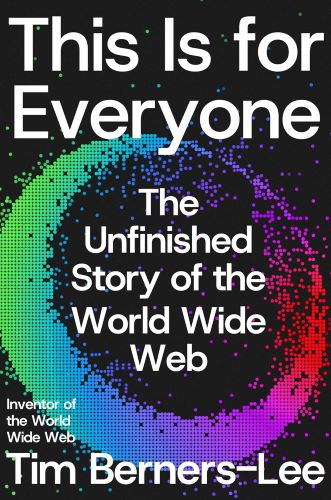
This is a summary of This Is for Everyone: The Unfinished Story of the World Wide Web by Tim Berners-Lee. It covers Tim’s invention of the web, the commercial and social forces that have reshaped it since, and Tim’s current push for data sovereignty.
[Estimated reading time: 32 mins]
Buy This is for Everyone at Amazon (affiliate link)
Key Takeaways from This is for Everyone
- How the web was born. While at CERN, Tim conceived of the World Wide Web (WWW) as a decentralised way of organising information. He saw links as being key and invented URLs as a way of navigating the web.
- Putting the web in the public domain. Tim lobbied CERN to put the web into the public domain after seeing the backlash when a competing network suggested it might someday charge royalties.
- Commercialisation of the web. During the early days of the web, small and medium sites dominated. But people soon realised there was money to be made:
- Advertising became the business model, and third-party cookies allowed advertisers to target users based on detailed profiles. Users became the product, not the customer.
- Sites that used addictive algorithms prioritising user engagement grew quickly. A few large platforms now command a disproportionate amount of web traffic. These algorithms have contributed both to political polarisation and to mental health issues.
- Other firms found ways to make money by becoming gatekeepers, controlling the .com registry, app stores and paywalls.
- Open standards and non-profits act as a counterweight to commercial interests.
- Tim founded the W3C in 1994 to keep updating the web protocols in an inclusive, non-profit setting, and to try to stop the web from splintering.
- Later, he and his wife set up the Web Foundation to push for improving Internet access and to address some of the harmful social impacts of the Internet.
- Data sovereignty. Our data is stuck in a variety of silos, in different formats, and is mostly read-only. Users do not have control over their data. Tim is currently focusing on promoting SoLiD, an open data protocol where users stay in control and apps only have access for limited purposes.
- AI.
- AI will have both positive and negative impacts, and the design choices we make today will be crucial. Getting the data layer correct will be particularly important for AI.
- Tim hopes that we stick to systems we can control, and build AI collaboratively in a CERN-like institution.
Detailed Summary of This is for Everyone
The book’s title comes from a statement that Tim chose when he appeared in the Opening Ceremony of the 2012 London Olympics. It reflects his vision of what the web should be.

A bit about Tim
Tim had a happy upbringing, and was the eldest of four children. Although his family wasn’t wealthy, Tim describes it as a “massive privilege” being born at the time and place that he was, to the parents that he had. He basically got a free education (including at Oxford) paid for by the government, and his parents were mathematicians and electronic engineers. Tim describes how his dad would line the kids up with balls to demonstrate queuing theory concepts, while his mum designed an ingenious system for household chores.
When he was a kid, Tim bought a bag of cheap factory-reject transistors, which he used to automate model trains. He later moved on to electronics and eventually computers. Like Steve Jobs and Steve Wozniak, he built his own computer from scratch while at Oxford.
It was neat in a way that throughout this whole process, just as I needed something which I could not build myself, like a transistor or, now, a memory chip that could hold each of the 1,024 characters in my new display, industry produced it at a cost I could afford. That’s why I feel my cohort – not my generation of baby boomers but more specifically the kids born close to 1955 – had a magic-carpet ride through the wave of tech. A few years earlier, everything would have been much too expensive or impossible. A few years later, it was all taken for granted and old hat.
— This is for Everyone by Tim Berners-Lee
After graduating with a degree in physics, Tim worked in telecommunications for a while. Later, he took up a job at CERN (the European Council for Nuclear Research) in Switzerland.
[There is some more personal stuff in the book that I’ve omitted, as this summary focuses more on the development of the web than on Tim’s life. Still, it’s pretty light on personal details (e.g. he never discusses personal or relationship struggles, even though he’s been through 2 divorces).]
How the web was born
Tim is often credited with “inventing the Internet”, but the TCP/IP protocols for connecting computers were actually invented by Vint Cerf and Bob Kahn. What Tim did was:
- combine two existing technologies (TCP/IP protocols and hypertext);
- create the World Wide Web, which let users navigate between web servers with hyperlinks;
- design URLs, HTTP and HTML; and
- build the world’s first browser and webpage.
Origins at CERN
The web was something that Tim came up with on the side. His day job was to program a data bus. Luckily, Tim had supportive bosses who gave him time and resources to work on his project. They also deflected criticism from those who questioned his project’s relevance to CERN.
There was an unspoken question that haunted the project, hinted at but never precisely articulated: ‘Why, exactly, is the European taxpayer financing the oddball passion project of a thirty-six-year-old computer programmer in the Data and Documents division of a Franco-Swiss particle physics laboratory?’
— This is for Everyone by Tim Berners-Lee
CERN is nevertheless integral to the story of the web because it was that collaborative environment that gave Tim the idea for the web in the first place. CERN used many different computers and information systems which couldn’t communicate with each other. To figure out how to run a given device, you’d have to find the person who managed it and ask them about it over coffee.
Tim started to imagine capturing all this information in a fractal and decentralised system, as it came in in random bursts. Eventually, there would form a picture of the whole system. This was very different from the hierarchical documentation systems prevalent at the time, where each document sat in a specific container. Many computer scientists at the time would have seen Tim’s design as ‘illogical’. What Tim was proposing was like taking a bunch of physical folders and dumping their contents onto the floor.
But Tim saw the links or relationships between different pieces of information as key. A hierarchical structure reduced the value of information by quarantining it into separate categories. By contrast, Tim’s decentralised system encouraged new and unexpected relationships to form.
In March 1989, Tim wrote a memo about a possible global information system. He predicted that the information management problems that CERN faced would soon become widespread. He also began talking about his idea constantly, but almost no one “got it”.
The web browser
Tim understood that each constraint added to a documentation system would alienate part of its user base. He began to think about splitting information into two layers:
- the server-end, which stored and managed the information; and
- the client layer, which would be based on hypertext, and would present the information in a flexible and user-friendly manner.
People could then go on working as they used to, while the information they generated would be captured and processed behind the scenes. Accordingly, Tim developed both server software and a web “client” that would render the pages written in HTML.
[T]oo often, software designers, like urban planners, make the mistake of demanding that the user – the human – acts like the system, rather than the other way around.
— This is for Everyone by Tim Berners-Lee
Tim’s first web client was a read-write tool, because he imagined users would edit webpages as well — sort of like Wikipedia. But it turned out users preferred to use different applications to read webpages and to write them, so the web ended up being a lot more “passive” than he intended.
Tim’s first web client only worked on NeXT computers. He later got a young intern (Nicola Pellow) to write a web client that would work with any computer. This was probably the first true web “browser”, in that it was read-only and platform-independent. [Imagine creating the world’s first web browser during your internship.]
URLs, HTTP and HTML
Tim also invented:
- URLs (Uniform Resource Locators) — Tim sees this as the most crucial piece of the web. There were two key aspects:
- URLs provided an entirely new way of navigating the web. Hypertext and hyperlinks already existed but, for whatever reason, back then people only used internal links to jump to other parts of the same document (e.g. to footnotes at the end of a paper). They hadn’t thought of using links to jump to other computers. Before, users had to type in a command and hit “Enter” to move between computers. Basically you had to know what you were looking for.
- URLs let you link to anything, with no restrictions on type, function or size. Before this, protocols could only direct users towards specific kinds of information.
- HTTP (HyperText Transfer Protocol) — a protocol designed to transfer information between computers as fast as possible. Tim also programmed those HTTP error conditions you’ve seen, like “404 Not Found”.
- HTML (Hypertext Markup Language) — this was developed as a standard format for hypertext. It was heavily based on another markup language (SGML) used at CERN for documentation systems.
By December 1990, Tim had hosted the world’s first web page:
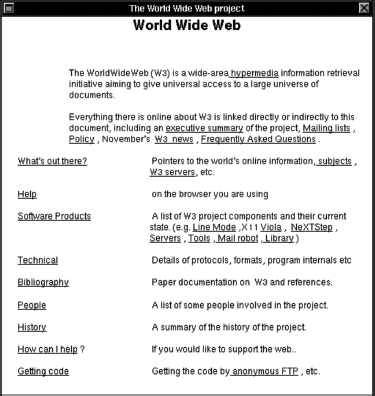
Funnily enough, the first “killer app” for the web was the CERN phone book. Tim put it onto a server to encourage people at CERN to install web browsers. By mid-1991, about a thousand people at CERN were regularly “using” the web … to look up phone numbers.
Putting the web in the public domain
In the early 1990s, the WWW was growing, but still had competitors. The biggest one was Gopher, which actually had more users because it hosted a free database of US Supreme Court decisions.
The University of Minnesota, which had developed Gopher, then announced in February 1993 that they were reserving the right to charge for the use of Gopher. They didn’t actually impose charges — they just said they might in the future. Still, that was enough to kill the technology, as the dominant ethos at the time was that the Internet should be free. Backlash was swift and people moved over to the WWW.
This prompted Tim to realise that CERN probably owned the WWW, since he had developed it while working there. He worried that a higher-up at CERN might also want to start charging for its use at some point, causing it to go the same way as Gopher. So he lobbied CERN to release the web’s source code into the public domain, relinquishing all intellectual property rights over it.
I wanted everyone to use it. I wanted it to be universal. I saw the technology and I saw how effective and easy to use it could be. Above all, I think, I just had a vision for it, a vision of all existing systems talking to one another, of everyone coming online.
— This is for Everyone by Tim Berners-Lee
Commercialisation of the web
Tim’s original vision of the web was a decentralised one, with users building their own sites and having complete control over their content. What actually happened was that a few digital platforms grew into large, unregulated monopolies.
I believe the web has been a massive positive force for humanity, but even in 2012, it was becoming clear that there were unintended negative consequences in what we were developing. As it had in the Industrial Revolution, the balance of power was swinging too far in favour of large corporations, not to mention governments, and away from individuals. The sense that the web was extracting value, in the form of personal data, from its users was something of growing concern for me. The sense that the web was surveilling users, rather than liberating them, was also a rising source of anxiety.
— This is for Everyone by Tim Berners-Lee
The early days
Before the 1980s, software was usually built collaboratively for free, with the for-profit sector operating mostly only in hardware. For example, the first web browsers were created by developers in the open source community. A computer science student named Pei-Yuan Wei invented a lot of standard features in browsers today, such as history, bookmarks, and the ‘Back’ and ‘Forward’ buttons.
Tim thinks early web culture was “delightful”, with visitor counters, guestbooks, webrings, and many “Under Construction” webpages. The underlying structure was diffuse and decentralised. Big players like YouTube and Facebook had not yet emerged to suck up the majority of traffic, so small and medium sites dominated. Early search engines sucked, and before Google people still relied on human-curated lists to find things.
Entrepreneurs later realised they could earn enormous profits in software by enforcing copyright protections strictly. Microsoft (and Bill Gates) was a key driver of this.
Advertising
A “cookie” is basically a data file on a user’s computer. First-party cookies are very useful, because otherwise you’d have to re-enter your password every time you visited a site. But third-party cookies can track your journey across multiple sites. Combined with other tracking technologies (e.g. invisible pixels and “beacons”), cookies could create incredibly detailed profiles of users for targeted advertising.
In 1995, DoubleClick revolutionised advertising by serving up targeted ads using cookies. Some social media sites use targeted advertising as their business model. For such sites, users are not the customers — they are the product. The advertisers are the true customers, because they pay for access to the users. Facebook for example offers hundreds of targeting options. Advertisers can target ads based on what kind of relationship a user is in, what kind of parent they are, their sexual preferences, their political views, and how often they’ve googled “am I dying” in the past year.
GDPR overregulation of cookies
While Tim doesn’t like third-party cookies, he thinks the EU’s GDPR regulation overreached, by forcing annoying “cookie consent” pop-ups even for harmless cookies. This could have been avoided if legislators had consulted technical experts and properly classified which types of cookies they wanted to regulate.
The good news is that there’s now a movement to phase out third-party cookies, with Firefox and Safari restricting them. [This prompted me to switch from Chrome to Firefox. It took about 10 mins, including signing back into various sites.]
Addictive algorithms
Some sites use machine learning techniques to make users addicted to their platforms. Neither machine learning algorithms, nor the desire to attract and retain users, are by themselves “bad”. There are a couple of platforms (e.g. Spotify, Pinterest) that seem to do a good job of helping users find content that is actually useful and enjoyable. But some sites like Facebook supercharged things.
By the early 2000s, Tim started to see that the web would decimate traditional media. Most web traffic today is concentrated in a handful of large platforms — a far cry from the much more decentralised early days of the web. Although social media is just a small part of the web, it commands a disproportionate amount of web traffic because it is so addictive. And because addictive algorithms prioritise engagement over enjoyment, the platforms feed people more extreme content. This has contributed both to political polarisation and mental health issues.
Broadcasting vs Narrowcasting
When misinformation is broadcast (as in traditional media), everyone can see what is happening, and the countervailing truth can be broadcast to combat it. But technology today allows misinformation to be narrowcast — i.e. the message can be targeted to people most susceptible to it. Such misinformation is less likely to be rebutted, because the broader public may not even be aware that the message is circulating.
The British political consulting firm Cambridge Analytica were experts in using Facebook’s incredibly detailed data to target voters, and played a role in both the Brexit campaigns and the election of Donald Trump in 2016. While these outcomes had many causes, Tim thinks social media bears some blame.
Tim is also concerned about the rise of deepfakes — highly realistic but fake images, audio and video. Paired with narrowcasting, they are especially dangerous: a deepfake targeted at the most susceptible people is incredibly hard to debunk. Even subtle deepfakes, such as telling people the wrong day to vote, could affect an election.
While Tim doesn’t think we should ban or get rid of social media, he does support the regulation of addictive algorithms:
What we have to block is not smartphones, nor even social media, but the harmful algorithms often used by social media – the psychological equivalent to giving kids access to a slot machine
— This is for Everyone by Tim Berners-Lee
Gatekeeping: domain names, app stores and paywalls
At various points, firms have tried to occupy key bottlenecks in the web in order to collect economic rents.
By the mid-1990s, it was obvious to some that fortunes were going to be made on the web; what was perhaps more obvious to me than to others was that the profit motive and possible monopolies might corrupt what I was trying to build.
— This is for Everyone by Tim Berners-Lee
Some examples include:
- Domain names. The US government sold off the ‘.com’ registry contract to Verisign, which was able to make huge profits by charging for .com domains. [Price increases are capped by regulation though.]
- Mobile app stores. Browsers are not nearly as dominant on mobile as they are on desktops, because providers often push users to download their app. (Reddit is a prime example.) For them, apps are more profitable as they can better track users. Tim also suggests that Apple deliberately throttled the functionality of its mobile browsers because it got a 30% commission from all app purchases and subscriptions.
- Paywalls. Even research and records produced with public funds can sit behind a paywall. Some people think this is indefensible.
Aaron Swartz
Aaron Swartz, one of the co-founders of Reddit, was an activist hacker who believed in a free Internet. He was connected to members of the hacktivist collective ‘Anonymous’, who would conduct denial-of-service attacks against targets they thought were unethical.
In 2008, Aaron downloaded a lot of US federal court records from PACER. Although court records are public information, they were still paywalled. A single case might cost several hundred dollars to access in full. Aaron thought this was unfair, so he and others put those downloaded records into a free online archive called RECAP. The US government and FBI both investigated Aaron’s activities, but ultimately didn’t file any charges.
A subsequent hacktivist attempt did not go so well. Aaron later used an MIT guest login to bulk-download articles from JSTOR, a paywalled academic library, as he believed that academic research funded by public money should be freely available to everyone. But MIT organised a sting operation, and caught Aaron downloading the papers. While he reached a settlement with both MIT and JSTOR, federal prosecutors brought a number of wire fraud charges against Aaron, carrying maximum sentences of up to 35 years in prison. On 11 January 2013, after negotiations for a plea bargain collapsed, Aaron committed suicide.
Open standards and non-profit counterweights
Tim fought against commercial pressures by setting up non-profits: first the W3C, and then the Web Foundation.
W3C
In 1994, Tim founded the World Wide Web Consortium (W3C) and left CERN to work on it full-time. The main purpose of W3C was to keep updating the web protocols as technology evolved, and to do so in an inclusive, non-profit setting.
Browser wars
Starting in 1993, a browser called “Mosaic” emerged and grew rapidly. Marc Andreessen, who was then an undergraduate student, was part of the team behind it. Marc paid close attention to user requests and his team rolled out new features quickly.
Tim was initially thrilled with the Mosaic browser, but later grew concerned. Mosaic seemed to be trying to hijack and rebrand the web — e.g. they’d talk about pages being “on Mosaic” instead of “on the web”. If Mosaic dominated the browser space, it might be able to unilaterally dictate new HTML standards and later profit from it.
After Marc graduated, he and much of his team began working on another browser, Netscape Navigator. Shortly after, Microsoft launched Internet Explorer. Both Microsoft and Netscape began to introduce browser-specific HTML features, including incompatible application scripting languages (JScript and JavaScript). Tim was worried this could splinter the web, with multiple protocols evolving independently.
Microsoft won the first “browser war” handily. But eventually both companies realised that they weren’t going to profit directly from browsers, and pivoted instead to making money off advertising on their browsers’ default home pages.
W3C established several offices in academic settings around the world. Their members included corporations, small businesses, non-profits, educational institutions and governments. Each year, a Technical Plenary Advisory Committee conference (TPAC) brought together around 1,000 people with a wide range of views to discuss what standards the web would use.
New standards for videoconferencing
W3C developed video-conferencing standards and published their first working draft of a Web Real-Time Communication (WebRTC) spec in 2011. These standards allow video calls to work across different browsers, so you aren’t forced to use the same browser as your colleagues or friends to do video calls with them. Today, the web clients for Zoom, Google Meet and Microsoft Teams all use the WebRTC standard for large-scale conferencing.
Overall, Tim thinks W3C has been successful. But it hasn’t always been easy, and W3C has lost some battles along the way.
Launch of Google Chrome
In 2004, Google had about a 90% share of search and a lot of clout within W3C — one of its developers (Ian Hickson) chaired the HTML development group.
After losing a vote on the direction of HTML5, that developer and representatives from Mozilla, Opera and Apple broke away to form a splinter group, the Web Hypertext Application Technology Working Group (WHATWG).
Shortly afterwards it emerged that Google had been secretly building its own browser. Google Chrome launched in 2008 and integrated seamlessly with WHATWG’s HTML5 standard. Google had pretended to be a neutral convener but was in fact a rival, steering HTML in the direction that the Chrome team wanted it to go.
Tim acknowledges that HTML5 was a more powerful evolution of web technology, because it let applications like Google Docs and Slack work within the browser, and W3C ultimately endorsed it. But he thinks the fracturing of W3C left the world worse-off as a whole, as it made the web more of a bloated, complicated mess, and was the first step away from the public commons he had envisaged.
The Web Foundation
In 2009, Tim and his third wife (Rosemary Leith) co-founded the World Wide Web Foundation (aka ‘The Web Foundation’). They were concerned about the growing global gap in Internet access, so they worked to close it. The Foundation also fought campaigns for net neutrality and to address some of the negative social effects of the web.
The fight for net neutrality
Internet providers can see who sends data packets where, because of the way the Internet addressing system works. In theory, this could let them charge different amounts for different data packets. For example, they might charge Netflix a premium to get its data sent first.
Net neutrality is the idea that every data packet on the Internet be treated equally. This means the market for content and the market for connectivity will operate independently. People developing content don’t have to worry about what internet speed will be available, and people working on network speed don’t have to worry about content.
Tim argues that net neutrality has allowed both markets to flourish. Without it, your choice of Internet Service Provider would also determine what content you get. It would be as if buying a car of a given make, also committed you to a package that determined which roads you could drive on. Fords might travel on completely different roads to Volkswagens.
During the course of his work, Tim travelled to different parts of Africa and met with government officials. The key thing was to prevent internet services from getting monopolised. Many vendors tried to become the sole provider of broadband, and offered to equip schools with WiFi in exchange. Part of The Web Foundation’s work was simply to encourage governments to hold out for better deals. [This has echoes with AI data centres.]
The free, open access communications paradigm we have did not arrive like magic. It was the product of a fair amount of political wrangling – we had to convince governments worldwide to deregulate the telecom industry; we had to fight for the ‘safe harbour’ provisions to ensure web hosts weren’t liable for offensive or defamatory user content; and we had to ensure a fair auction of the radio spectrum for wireless communications.
— This is for Everyone by Tim Berners-Lee
In 2024, Tim and his wife wound down the Web Foundation. By that time, 70% of the world’s population was already online, which achieved a great part of the Foundation’s original mission. The other part of its mission focused on the social effects of technology was still unsolved, but many other non-profits were now working on it. Moreover, Tim’s focus had now shifted to data sovereignty (see below).
Data sovereignty
When used well, data can improve the lives of ordinary people and help governments make more informed decisions.
Government use of data
Tim played a role in the launch of Data.gov.uk in 2009, and later co-founded the non-profit Open Data Institute (ODI). The ODI helps governments build digital tools to interpret data, and make anonymised data such as census info and official statistics available to ordinary citizens.
But data can also be — and often is — used to help businesses entrench their market power and extract value from consumers.
Tim was blocked from his own spending data
Tim used to use Quicken to do his accounting, but stopped after the software served up an advertisement based on his own data. He felt that violated his privacy, and moved to his own system, using Python code to download credit card statements to his laptop.
However, after several years the code stopped working. It turned out that Tim’s bank had entered a deal with an accounting software firm, and had blocked his Python programs from accessing his own spending data. This was not how he wanted the web to work — he didn’t want his choice of accounting software tied to his choice of bank!!
Tim began to advocate for the idea of data sovereignty — the idea that individuals should not only have control over their own data, but be empowered by it. Every day, we generate a lot of data in systems like banks, GPS devices, and cameras. But most of that data is read-only, and comes in a variety of formats. The data is stuck in “silos” — some data is on our phones, some in our bank statements, and some with our health providers. These silos prevent us from combining our own data from various sources in order to gain new insights about ourselves. They also make it harder for us to switch platforms.
Why is your smartwatch writing your biological data to one invisible silo in one format? Why is your credit card writing your financial data to a second silo in a different format? Why are your YouTube comments, Reddit posts, Facebook updates and tweets all stored in different places? Why is the default expectation that you aren’t supposed to be able to look at any of this stuff? You generate all this data – your actions, your choices, your body, your preferences, your decisions.
— This is for Everyone by Tim Berners-Lee
SoLiD data protocol
Tim developed the open protocol SoLiD (Social Linked Data), as a solution to these data silos. The idea is that each user has a data “Pod”, which stores all of their personal data. When, for example, you use your credit card, data will be directly written to your pod, instead of some file in your bank’s database. You would then be free to link this data to your preferred tax or accounting app. Similarly, data generated by your smartwatch won’t be locked to Apple, Samsung, or Garmin’s ecosystem, and can feed directly into your medical records if you want.
How you use or share the data in your Pod is then up to you. When an app or website asks you to fill in a form, you can give it access to the relevant data from your pod, but only for that limited purpose. If you change your address or phone number, you’d only need to update it once in your Pod. Users could browse a pod like a folder on their computer — exploring the data, amending it, and seeing who it’s been shared with.
An Intention Economy
The term “intention economy” was coined by Doc Searls. In contrast with an “attention economy”, the intention economy describes a world organised around buyers’ intentions, where vendors compete to provide the things that people actually want.
For example, if you’re planning your next family holiday in the intention economy, you can share all of the personal data stored in your family’s data pods with a travel agent, but just for a moment. Once the travel agent has generated personalised recommendations or an itinerary, it loses access to your data. This could be possible with strict privacy controls.
SoLiD is still at an early stage. Tim founded a company (Inrupt) to try and commercialise and promote the technology (this is the first time Tim has founded a company, as opposed to a non-profit). So far, they have had some success convincing data providers to use SoLiD, with the Flemish part of Belgium (with 6 million people) being an early adopter. They are also hoping to attract some early users from the existing “quantified self” or open-data communities.
[I find the idea of SoLiD pretty exciting, but it really depends on network effects to be useful and it hasn’t reached that scale yet. Hopefully that changes with time.]
AI
The first time Tim used ChatGPT, he was amazed. Even back in 2010, AI was beginning to achieve things that his parents had told him computers could never do, such as translating between languages or recognising visual objects. But every time it reached some new milestone, people stopped calling it “AI”. Instead, they’d call it “language translation” or “pattern recognition”, denying AI the credit.
AI’s impact will depend on the choices we make now
The potential impact of AI is complex — it can be good or bad depending on the context, and the design choices we make. Tim believes that, with AI, we are at the edge of the greatest technological shift of his lifetime. Getting the design choices right will therefore be crucial.
From my work with the early web, I knew that design choices made at the start would shape the nature and values of what was to come – and once those first design choices were made, they were very hard to change … . This time [with AI], getting the design right at the outset is more important than ever before.
— This is for Everyone by Tim Berners-Lee
A CERN for AI
Tim remains “tremendously excited” about the potential for AI, and uses several AI tools himself. However, he also recognises AI’s dangers. The technology is already at a stage where AI “agents” can autonomously pursue goals. If those goals are not aligned with humanity’s best interests, the danger will grow as AI agents gain more power. In extreme cases, a highly capable but misaligned AI could even threaten humanity’s survival.
Tim therefore believes we should make sure that we stick with systems that we can control or contain. The wise thing to do would be to build the AI in a sandbox, where it cannot acquire more resources or affect the real world. It would be best to do this in a CERN-like institution of global collaboration and governance. In late 2024, Demis Hassabis issued a call for such an institution.
[CERN] was founded just a few years after the appalling bombings of Hiroshima and Nagasaki. As CERN provided a collaborative environment for research, the Strategic Arms Limitation Treaty and other similar bodies managed the Cold War standoff without destroying the world.
— This is for Everyone by Tim Berners-Lee
The first global summit on AI in 2023 had a significant safety focus, but subsequent summits have focused more on innovation. Nevertheless, Tim believes there is still an opportunity to establish a CERN-like institution for AI before something catastrophic happens.
Getting the data layer right will be critical
Data is an essential input for AI. To make sure AI systems won’t exploit us, we must get this layer right. Currently, we trust banks, doctors and lawyers with a lot of our sensitive information, because there are laws in place (e.g. attorney-client privilege) that stop them from using that information to exploit us. Tim hopes that our communications with our AI agents will be privileged and confidential in the same way.
It’s also important to have an AI that respects your data and works for you, rather than for big tech or other businesses. Tim doubts that the market will naturally provide this, as the experience with social media has shown — the systems that didn’t act in the user’s best interests have often been the ones that flourished. A powerful AI might exploit us in subtle ways we can’t even detect. So Tim’s company, Inrupt, has set about developing an AI assistant (Charlie) that puts the user’s interest first. [Charlie is not publicly available yet.]
Data remains the fuel for AI, and if we can’t develop systems with user control at their core, I fear we will encounter the same problems with privacy and exploitation as we have with social media and search.
— This is for Everyone by Tim Berners-Lee
Other Interesting Points
- Tim has received a bunch of awards and honours: he was knighted in 2004 “for services to the global development of the Internet”, appointed to the Order of Merit in 2007, and won the Turing Award in 2016. But he seems to find the 2022 Seoul Peace Prize especially meaningful, because it credited his work on data sovereignty, rather than his work in building the web.
- The world’s first blog is arguably Design Issues. On that page, Tim has been recording his thoughts about the challenges the web faces ever since his time at CERN.
- Steve Jobs — Tim is overall very complimentary of Steve Jobs’ NeXT computer, which he used to develop the web. There was a bit of a “sliding doors” moment when Tim showed off his web technology at a NeXT developers’ conference, but Steve got called away before he could reach Tim’s table. Tim was crushed — he never got to meet Steve.
- Al Gore was critically important to the web’s success:
- Gore got the US Congress to authorise around $600m to develop the Internet. This funding helped the Internet move from academic to widespread public use.
- Tim writes: “He had a far-sighted vision for putting technology in public hands, and his funding came at a critical time. He did not invent the internet, but there is no politician, anywhere, who can claim as much influence on the subsequent development of the internet as Al Gore.”
My Review of This is for Everyone
I really liked the book, and expect it will make my top 3 list this year. I’m not normally a fan of memoirs, but this one isn’t really about Tim’s life (though he does talk about his life more than this summary suggests). The book is more like a short history of the Internet seen through the eyes of someone who was right there shaping things from the very beginning, mixed in with Tim’s personal views on the challenges that the Internet brings.
The book never goes deep into any particular issue (it gets closest with data sovereignty), opting instead for breadth of coverage. Tim has a natural and easy writing style, and he’s good at explaining technical concepts simply. It’s also fun to hear Tim’s opinions on some of the famous people he’s met (the Queen, Marc Andreessen, Mark Zuckerberg, Demis Hassabis).
I appreciated Tim’s story as a valuable counterweight to the common narrative that tech billionaires like Zuckerberg and Bezos “deserve” their wealth because millions of people use their services. Tim has arguably created more value than most of them, but is far from a billionaire. He’s no doubt well-off, but he seems to have focused more on building great things than on capturing value from them. I don’t know many people outside of tech circles who have even heard of him, which is a shame.
Let me know what you think of my summary of This is for Everyone in the comments below!
Buy This is for Everyone at: Amazon <– This is an affiliate link, which means I may earn a small commission if you make a purchase through it. Thanks for supporting the site! 🙂
If you enjoyed this summary of This is for Everyone, you may also like:
- Book Summary: Algorithms to Live By by Brian Christian and Tom Griffiths
- Book Summary: A Hacker’s Mind by Bruce Schneier — Schneier is also involved with the SoLiD project, and is the Chief Security Architect at Tim’s company, Inrupt.
- Book Summary: Why We’re Polarized by Ezra Klein