[Estimated reading time: 23 mins]
Buy Kaput at Amazon (affiliate link)
Table of Contents
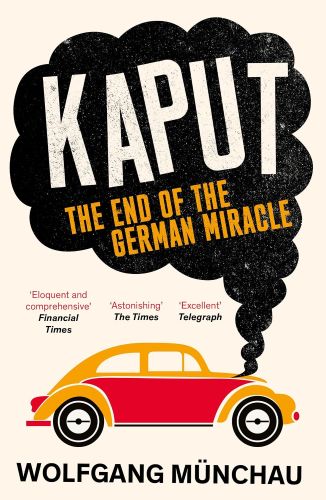
In Kaput: The End of the German Miracle, Wolfgang Münchau argues that Germany’s decades-long model of neo-mercantilism has failed, and that the country now faces structural decline.
Key Takeaways from Kaput
- Germany’s economic model is fundamentally flawed:
- It is neo-mercantilist, in that it prioritises large trade surpluses in physical goods, and protects domestic industries to do so.
- The financial system is part of the model. Germany’s state-owned banks channel savings to favoured old industries, while its capital markets are underdeveloped.
- Germany is also fiscally conservative. Its constitutional debt brake starved public investment for over a decade.
- Between 2005 and 2015, Germany enjoyed a second “economic miracle”, thanks mostly to luck. Those tailwinds have now died out, leaving Germany in structural decline.
- The country is captured by industry, particularly the car industry:
- All sides were complicit: the left wanted the manufacturing jobs, the right wanted the profits, and the Greens wanted a green industry.
- The German economy has too much risk concentrated in the car industry, which is now being threatened by the shift to electric vehicles.
- German industry has long supported trade with Russia. Some argued that trade would help liberalise Russia. But the industry also depended on cheap Russian gas.
- China has grown into a systemic competitor, and Germany is split on how to deal with it.
- Germany’s culture is holding the country back:
- Technophobia. A wariness of all things digital, compounded by poor policy decisions, has left Germany with poor digital infrastructure.
- Failure to attract high-skilled migrants. A culture of discrimination and bureaucratic hurdles keep Germany from attracting the skilled immigrants it needs to diversify away from industry.
Detailed Summary of Kaput
Germany’s economic model is fundamentally flawed
Neo-mercantilism
The German model is neo-mercantilist, in that its goal is to create large export surpluses, especially by trading in physical goods.
Everybody in Germany supported the neo-mercantilist model. German newspapers celebrated Germany’s export surpluses the way newspapers elsewhere wrote about sports. For several years running, the German media declared Germany the “export world champion” (usually a contest between Germany and China). But this label is meaningless because it celebrates an economic imbalance — an imbalance that turned out to be very unhealthy.
Of course, it’s not possible for all countries to run surpluses at the same time. So Germany’s growth is reliant on other countries (especially the US and UK) running deficits. A rule of thumb seems to be that whenever its current account surplus disappears, Germany enters a recession.
— Wolfgang Münchau in KaputThere is nothing wrong with current-account surpluses or deficits. There are no right numbers. The problem with the current-account surplus is the massive size — and the persistence.
Many who defend Germany’s surplus claim that it is the natural result of private sector decisions. But Münchau counters that the government could have borrowed to invest more, which would have reduced the surplus. Instead, the German companies responsible for the surpluses just reinvested their money abroad into the same old technologies.
The financial system behind neo-mercantilism
Germany’s financial system supports its neo-mercantilism. Capital markets in Germany are underdeveloped, with the banking system as the main source of finance. The system includes a large state banking sector (the Landesbanken), geared towards large and stable corporate investments. The justification for this system was that industry has longer time horizons, and capital markets are not suited for investment that takes decades to pay off. Münchau used to accept this argument but no longer does, because industry has also become very short-termist.
The Landesbanken don’t just lend money; they also take strategic stakes in companies and are often represented on company boards. They are serious political players in Germany, yet their lending is not subject to parliamentary scrutiny. This enables corruption — politicians can give out favours while bypassing the usual controls on public investment. In some cases, banks have even been used in election campaigns. Moreover, Landesbanken tended to recruit based on who you knew rather than what you knew, so many of their bankers didn’t really understand modern financial markets. [This seems pretty bad if true.]
Questionable WestLB activities
WestLB in North Rhine-Westphalia was one of the largest Landesbanken. In the early 1990s, it facilitated a hostile takeover in the steel sector by secretly buying shares in the target company (Hoesch) and then selling them to the acquiring company (Krupp).
Münchau claims that the SPD-led state government colluded to make this happen, as the leader (Johannes Rau) sat on the board of the Krupp Foundation at the time. Rau, however, denied that his government played any role in the takeover.
WestLB also bailed out multiple private companies, including an engineering company and a private TV station.
The Landesbanken shaped the industrial structure of their states by picking winners. This is how North Rhine-Westphalia ended up with a massive dependence on coal, steel and energy. Some punts in Munich in media, chemicals, energy and electronics turned out more successful. Those have helped Munich become Germany’s high-tech centre. However, the fundamental problem is that the German financial system makes it hard for the economy to diversify into new sectors, and so the country continues to depend on industries long past their prime.
The German establishment has a general disdain for services. Münchau once asked a well-known economist about diversifying from industry to services. He thought that this would be a thoroughly bad idea, because he didn’t want Germany to end up like the UK with its “dodgy financial institutions”.
Münchau thinks Germany’s financial sector shares some similarities with China’s, which may be why both countries pursue neo-mercantilist policies. Germany’s system is just more decentralised.
Fiscal conservatism and the debt brake
Germany’s fiscal policy is geared towards balanced budgets, and there is a strong aversion to government debt. When the economy falters, there are some automatic stabilisers (e.g. unemployment insurance), but the idea of fiscal stimulus is “alien” to Germans. When forming the European Union, Germany insisted that central bank independence and a mandate to focus exclusively on price stability be written into the Maastricht Treaty, because it didn’t trust the rest of Europe.
Even the centre-left in Germany are fiscal conservatives. Despite producing some of the most competent finance ministers in Germany’s history, during the 1970s the Social Democratic Party (SPD) started to get paranoid about being painted as “profligate”. By the 1980s, fiscal conservatives had taken hold everywhere. In fact, Peer Steinbrück, deputy leader of the SPD and former finance minister, was responsible for Germany’s debt brake, which Münchau “probably the worst fiscal rule by any government anywhere”.
How the debt brake works
The debt brake was written into Germany’s constitution in 2009, and limits annual structural deficits to 0.35% of GDP. (There are nuances — e.g. the debt brake can be suspended during fiscal emergencies, like during Covid-19.)
But the big problem with the debt brake is that it does not discriminate between spending and investment. Sometimes it may make sense to run larger deficits and take on extra debt in order to fund investment that will pay off in the longer run. When resources are tight, long-term investments are easier to cut, so the debt brake led to years of public underinvestment In Germany.
[In 2025, the outgoing German parliament passed a constitutional amendment exempting some defence and infrastructure spending from the debt brake.]
Germany’s “second economic miracle” was mostly luck
Between 2005 and about 2015, the media celebrated Germany’s “second economic miracle” (Wirtschaftswunder). But Münchau argues this was just luck — Germany managed to prolong its outdated industrial model for a few more years, but this was not repeatable.
— Wolfgang Münchau in KaputLiberals everywhere looked at Germany as an alternative model, politically and economically. They did not look under the bonnet. They did not see, or did not want to see, that the policies of the German government were hardly changed from those of decades earlier.
Factors that contributed to Germany’s “economic miracle” included:
- Labour-market reforms that led to wage moderation and increased Germany’s price competitiveness;
- Cheap gas from Russia;
- The rise of China, which created strong demand for industrial plant and machinery from Germany;
- Cheap credit — the eurozone crisis increased demand for German government bonds, which were seen as a safe haven asset; and
- A massive devaluation of the euro against the dollar during the euro crisis in 2010 — this benefited exporters like Germany and the Netherlands.
Those tailwinds are now gone. Much of the public narrative has focused on energy prices, but the deeper causes of Germany’s stagnation go decades back. The energy crisis simply revealed how Germany has no competitive advantage in energy, so it doesn’t make economic sense to locate high-energy-consuming industries there.
Münchau thinks Germany is now in “structural decline”, such that the economy will fluctuate around a lower average growth rate. To reverse this, Münchau thinks the main reform needed would be a full-blown European capital markets union. That would break the “toxic nexus” between banks and their home governments and industry, and allow capital to flow to the most profitable businesses. (He doesn’t offer other suggestions, as Kaput is meant to be “a narrative of what happened, not a policy book”.)
Germany had the majorities needed to push through such a reform during the Merkel years, but didn’t. Reform has only gotten harder as the political landscape has now become too fractured. Together the far-right and far-left in Germany account for around 25% of electoral support. [Current polling suggests it’s considerably higher now.]
The country is captured by industry, particularly the car industry
Everyone was complicit
Both the left and the right support Germany’s industrial model:
- Left: Many voters for the SPD come from the industrial towns of the west. (There are divisions within the party, though — one faction has trusted the US and NATO more, while another faction wanted Germany to take an “equidistant” position between the US and Russia.)
- Right: After the fall of the Berlin Wall, the Christian Democratic Union (CDU, the main centre-right party) also supported closer relations with Russia, thanks to the influence of the German Eastern Business Association, Germany’s most powerful lobby group. The strongholds for the AfD (far-right) are also in the old industrial towns in the east.
— Wolfgang Münchau in KaputFor all their political differences, they all agreed on this. The right wanted industrial profits. The left wanted industrial jobs. The Greens dreamt of a green industry. Nobody questioned the over-reliance on industry itself.
The German car industry
Too much risk is concentrated in the car industry. In Germany, the car industry directly employs 786,000 people, and 7 out of 40 stocks in Germany’s DAX stock index are car industry companies.
Some specific examples of the car industry wielding its influence include:
- It was a Volkswagen director who led Schröder’s 2003 economic reform programme.
- The chief of Porsche (Oliver Blume) was close friends with Christian Lindner, when he was Germany’s finance minister. At one point during the EU negotiations to phase out fuel-driven cars, Blume boasted at one point that Lindner had updated him “almost hourly”. [Records show that Blume had been exaggerating, though it’s true that the two were in contact during the negotiations.]
- After it was discovered in 2015 that a bunch of car makers had installed software to mislead emissions testers, the German government continued to help them.
The problem now facing Germany’s car industry is the transition to electric vehicles (EVs). German EVs are not competitive overseas because they are too expensive and don’t offer the best driving experience. The car industry’s experience building fuel-driven cars is not very helpful for building EVs, because they are very different beasts. EV engines don’t have nearly as many parts as combustion engines, and they are different parts. Most of a modern electric car’s value lies in the software and the battery.
— Wolfgang Münchau in KaputA Tesla is an iPad with wheels — in fact, it’s easier to operate than an iPad.
In the past, China was an important export market for German automakers, with Volkswagen, Mercedes and BMW each selling around 1/3 of their cars there. But their market shares in China have been falling (especially in EVs), while Chinese automakers’ market shares in Europe have been rising. After Covid-19, China overtook Germany and Japan to become the world’s largest car exporter. Germany may still retain a niche in producing status-symbol cars — but that is a small niche.
German industry supported trade with Russia
Nobody in Germany wanted to look too closely at what was happening in Russia, even though there had been reports of political assassinations there since the early 2000s. Many German businessmen used to argue that trade with Russia would “liberalise” it. [Interesting — I’d only heard this argument made with China before.] This claim went unchallenged in the public discourse, right up until Russia invaded Ukraine in 2022.
One example is an article jointly written by the German and Russian foreign ministers in 2010, which Münchau says was a “typical example of German thinking”. As is often the case in German-Russian relations, they referred to the long history between the two countries, before calling for closer cooperation and establishing a ‘modernisation partnership’ to do so.
One of the main proponents of closer ties with Russia was former chancellor Gerhard Schröder.
Gerhard Schröder, the “quintessential character of modern German neo-mercantilism”
Schröder, former leader of the SPD, was German chancellor between 1998 and 2005. He earned a reputation for protecting jobs after intervening to rescue a steel business and a large construction company.
Schröder’s government also pushed through a merger of energy companies, overruling objections by both the Federal Cartel Office and the independent Monopolies Commission. He also pushed to deepen energy cooperation with Russia.
In the first 2 years after taking office, Schröder met with Putin 11 times. Schröder and his family even visited Putin’s house for Orthodox Christmas in 2001. After leaving office, Schröder worked for Russian energy companies as well as the Nord Stream 2 consortium. Even today, Schröder is still friends with Putin, and attended a party at the Russian embassy after the invasion of Ukraine.
In Germany today, he is a much-diminished figure, and his party has tried to expel him.
Germany’s pro-Russia stance outlasted Schröder. It weakened under Angela Merkel’s centre-right CDU government. Many CDU politicians weren’t “pro-Russia” per se; they were just “pro-business”, and supporting Russia helped them win support from industry. Nevertheless, dependence on Russian gas grew under Merkel’s grand coalition with the SPD.
This explains why Merkel struggled to get support for sanctions against Russia after it annexed Crimea in 2014. Before the 2014 sanctions, trade with Russia had grown constantly. After the sanctions, German exports experienced a sharp downturn, with smaller firms in eastern Germany hardest hit. Münchau thinks this contributed to the rise of the AfD.
Russian energy
In 2011, after the Fukushima nuclear accident, Angela Merkel imposed a mandatory nuclear exit by 2023, which increased Germany’s reliance on Russian gas. In response to claims that Germany had become dependent on Russia, people would argue that Russia was similarly dependent on Germany.
But Münchau argues there is no such thing as true interdependence. One partner is always in a relatively better position. In Germany’s case, it depended on Russia for gas more than Russia depended on it as a customer.
The 2014 sanctions didn’t apply to Russian gas, which kept flowing until after the 2022 Ukraine invasion.
Effect of cutting off Russian gas: economists vs real businesspeople
After the Ukraine war broke out in 2022, a group of economists modelled Germany’s dependence on Russian energy and found that cutting off all Russian energy would have costs that were “substantial but manageable”. The estimated GDP decline was between 0.5% and 3%.
Olaf Scholz, chancellor at the time, immediately ridiculed this study. He called it “irresponsible” to apply such mathematical models, saying he would rather take advice from real businesspeople. Those “real businesspeople”, of course, predicted disaster, and some had ties to Russia.
As things transpired, Russia gradually cut off gas to Germany anyway, and then the Nord Stream pipeline was sabotaged. The economists’ estimates turned out to be far closer to what happened than the businesspeople’s predictions of disaster.
China has become a systemic competitor
For a long time, Germany saw China as an opportunity. Beginning in the 1980s, Germany sent large delegations to China. It established major joint ventures with China, helped build Shanghai’s metro system, and gave China a lot of development aid. Many Western countries at the time, including Germany, thought that China would become a democracy as it developed. And Germany and China are both industrial mercantilists, which may explain why they got on so well.
But Münchau argues that the relationship was never on equal terms. German companies investing in China were subject to controls and had to hand over their know-how to joint-venture partners, while the converse wasn’t true.
Unequal dependence
Münchau calls China the “de-risker par excellence”, as it has always prioritised supply chain security. As such, the rest of the world is far more dependent on China than China is on the rest of the world. [I suspect China’s scale makes it much easier to de-risk. Its high degree of top-down control also helps, since de-risking requires pushing against market forces.]
While China still depends on Germany in some sectors (mostly engineering, aerospace vehicles, and special pharmaceuticals), Münchau thinks Germany’s dependence on China is far greater.
One ‘study’ found that most German companies simply had no physical alternatives to China, such that de-risking their supply chain was out of the question. [This is misleading. First off, it wasn’t a “study”. It was (at best) a survey of 46 self-selected firms that were already interested in China for some reason. Secondly, the link shows the main objection does seem to be the cost, time and effort involved. This directly contradicts Münchau’s claim that it was “not just about cost”, and that these firms “simply have no physical alternatives”.]
Attitudes towards China began to change in the 2010s, as China moved in on Germany’s solar panel market. Then in 2016, the Chinese firm Midea acquired a German robotics company, which set off alarm bells about technology transfer. Later, the Covid-19 pandemic prompted concerns about the dependence of German supply chains on China.
Today, people in Germany are divided about how to approach China. Some German CEOs want to maintain good relations with China, and don’t want Europe to take sides between the US and China. There are clear parallels with the efforts to maintain trade with Russia to keep the export model. But the German business community no longer takes a uniformly pro-China stance, and there are disputes happening within boardrooms and between shareholders over China.
Germany’s culture is holding the country back
Technophobia
Münchau thinks Germany might be the most technophobic country in the Western world, and that its mercantilist mindset goes “hand in hand” with technophobia. [Interestingly, Münchau claims China is also mercantilist, yet they are clearly not technophobic.] Germany’s digital infrastructure is weak, and teachers are particularly wary about the potential harms of digitalisation.
Germany wasn’t always so technophobic. It used to be very strong in STEM subjects, and its most famous university (Göttingen) boasts 47 Nobel Prize winners. But after the Nazis rose to power in the 1930s, many scientists fled to the US.
Still, that didn’t make Germany technophobic. Even in the 1970s, the country was relatively tech-friendly. But then it made a series of bad decisions that left it with crappy digital infrastructure:
- Copper and coaxial cables. In the 1980s and 1990s, Germany built analogue cable-TV infrastructure with copper and coaxial cables instead of laying down fibre. By 2021, 7 out of 10 German households still used copper cables, with very slow internet connection speeds. Fibre only accounted for 10% of internet connections, as compared to the OECD average of 35.5%.
- Mobile phone networks. When Germany auctioned licences from the early 2000s, it prioritised revenue maximisation, which led to poor coverage outside of cities. Münchau thinks this is one reason why German industry could not become leaders in electric cars — they couldn’t test navigation apps on German streets.
- Dot-com bust. During the boom, a penny stock market (the Neuer Markt) was hyped up in Germany. That market suffered an incredible 96% loss between March 2000 and October 2002 and ordinary savers lost large amounts. Many came away thinking “never again”.
Successive governments have made big promises about upgrading the country’s digital infrastructure, but have not fulfilled them. This poor infrastructure has had knock-on effects. Münchau gives several anecdotal examples of startups facing long delays and bureaucracy in trying to get connected to the necessary infrastructure.
Isn’t Germany the most innovative country in the world?
In 2018, Germany was ranked the most innovative country in the World Economic Forum’s Global Competitiveness Index.
But these rankings lean heavily on patents, and Germany’s are mostly old-industry patents from the car and chemicals industries. Münchau thinks that these innovations have a lower marginal utility than AI-driven technologies from Google or Microsoft, because digital technologies cannibalise some of the older technologies. For example, the smartphone made the camera, torch, compass, map and rolodex all obsolete, and many of these had been made in Germany.
Münchau acknowledges there will still be demand for German precision tools and energy plants, but these come with lower growth rates, profit margins, and wages. [This is asserted without any evidence.]
Münchau admits that some German universities are still very good. The problem lies in the linkages between universities and traditional industry. In the past, those linkages worked well, and Germany’s vocational training system is widely admired for its ability to train skilled craftspeople. However, the labour market is heavily tilted towards the skills that German industry needs, but have not been updated for modern industries. For example, car mechanics today should really understand electronics, yet the training infrastructure has struggled to keep up.
Germany fails to attract high-skilled immigrants
Germany fails to attract the high-skilled immigrants it needs to diversify away from its existing economic model. The problems have more to do with culture than with policy, as Germany’s immigration regime is not particularly restrictive.
Münchau gives several reasons why potential high-skilled migrants are put off Germany:
- Language. This is a big problem, as not many migrants already speak German. [It’s also not an easy language to learn.]
- Cultural discrimination. Münchau says the society has “built-in discrimination” against anyone or anything from outside Germany. (See Saxony example below.)
- Bureaucratic hurdles. Immigrants need to meet all sorts of small conditions. For example, entrepreneurs needed to prove that their business served an overriding economic interest or specific regional need, and that it would create positive spillovers for the economy. Moreover, Germany’s poor digital infrastructure makes it harder for migrants to get their issues resolved.
Saxony’s two-tier school system
The state of Saxony runs a two-tier school system:
- one tier has grammar schools leading to a high-school degree and the opportunity to go to university; and
- a “lower” tier where children typically begin an apprenticeship at age 16.
Children who have previously attended a foreign school are automatically put into the lower tier for years 5 to 9. The presumption seems to be that a foreign education is worse than a German one, which is absurd seeing as Germany’s PISA rankings have been falling.
Münchau provides various anecdotal examples of highly educated foreigners being refused for jobs because they are “overqualified” or because their German language skills weren’t strong enough. [This is very common in many countries, even those that are welcoming to immigrants. It’s just harder to assess the value of a foreign degree and foreign experience. And I think it’s very understandable for employers to be reluctant to hire someone who is not fluent in the language used in their workplace.]
Germany simply cannot afford to be that picky, because it doesn’t have the oversupply of labour it had 20 years ago. Companies and economic institutes consistently cite skills shortages, especially for highly qualified workers, as the biggest structural problem facing the economy, and the number of unfilled jobs has only grown over the past decade.
— Wolfgang Münchau in KaputGermany had never had problems attracting low-skilled workers, which was what informed their policies. But they applied the same principles to high-skilled workers, as though highly skilled computer scientists were queuing up outside the borders, begging to be let in.
However, despite Münchau’s various gripes, he thinks Germany is moving in the right direction, having increasingly liberalised its immigration system.
Other Interesting Points
- The AfD had been founded by economics professors who hated the euro but were pro-immigration. After the influx of Syrian refugees from 2015, the party was taken over by anti-immigration right-wing supporters, and the professors were pushed out.
- Münchau claims there were more lawyers than economists in Germany’s finance ministry.
- Münchau has a fairly high opinion of Angela Merkel, calling her “the most accomplished political leader in Europe and one of the few who read her briefs”.
- Apparently many German politicians hold PhDs of dubious pedigree, because PhDs used to be considered helpful to a political career.
- Münchau worries that the next eurozone crisis will involve France, which has had years of rising deficits but is “too big to fail, and too big to save”.
- Münchau claims it was easy for firms to get around the Crimea sanctions, which were poorly monitored. They could simply set up production facilities directly in Russia, and the Russian government provided subsidies for doing so. German direct investment in Russia went from negative in 2014 to €1.78 billion in 2015, the highest since 2010. This fell to €1.08 billion by 2016, though. [Setting up production facilities in Russia comes with a lot of risk though, particularly if sanctions tighten. Also, subsidies provided by Russia will weaken the Russian government’s fiscal position.]
My Review of Kaput
This was an interesting one. On one hand, I feel like I learned a lot, simply because I knew so little about Germany beforehand. On the other hand, because I knew so little about Germany, it was hard to assess how fair Münchau was being.
During my first read-through, I was shocked at how much of a corrupt basketcase Münchau made Germany out to be. So I fact-checked Kaput more heavily than usual — see Fact-checking Kaput. While my fact-check verified some things I found surprising (e.g. Gerhard Schröder’s ties with Putin to this day), it also confirmed my suspicions that Münchau is a sloppy writer. Kaput definitely feels like a book written hastily by a journalist than a book written by an academic.
Despite the lack of rigour, I still learned quite a lot reading and summarising this book. Partly this was because the fact-checking process forced me to engage more deeply than I otherwise would’ve. But it was also useful to read a perspective that I hadn’t really seen before from someone who seems influential. 1Münchau has a weekly column in the Financial Times, and Yascha Mounk and Tyler Cowen had both praised Kaput, with Cowen calling it “the best and most detailed account of the German economic decline to date”. I also find it plausible that the book’s broader arguments — about Germany’s economic model being unsustainable and being too captured by industry to change it — are accurate, though I don’t trust Münchau enough to take him at face value. The jury’s still out on that one for me.
Anyway, to summarise, my assessment of Kaput is: it’s thought-provoking and interesting, but be prepared to discount Münchau’s claims, and fact-check anything you are tempted to repeat later.
Let me know what you think of my summary of Kaput in the comments below!
Buy Kaput at: Amazon <– This is an affiliate link, which means I may earn a small commission if you make a purchase through it. Thanks for supporting the site! 🙂
If you enjoyed this summary of Kaput, you may also like:
- Book Summary: How Asia Works by Joe Studwell
- Book Summary: Chokepoints by Edward Fishman
- Book Summary: Economics – The User’s Guide by Ha-Joon Chang
- 1Münchau has a weekly column in the Financial Times, and Yascha Mounk and Tyler Cowen had both praised Kaput, with Cowen calling it “the best and most detailed account of the German economic decline to date”. ↩︎