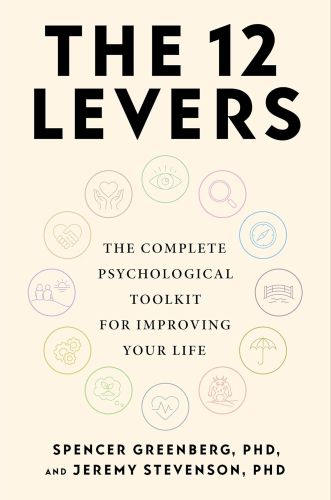
This summary is for The 12 Levers: The Complete Psychological Toolkit for Improving Your Life by Spencer Greenberg and Jeremy Stevenson, a book that attempts to distil the most useful techniques from over 100 self-help books into just 368 pages.
Spencer Greenberg founded Clearer Thinking, a research organisation that conducts studies and creates digital self-help tools for the public (including many linked in this summary). Jeremy Stevenson is a clinical psychologist, and the book shares some of his clients’ stories.
[Estimated reading time: 30 mins]
Buy The 12 Levers at Amazon (affiliate link)
Key Takeaways from The 12 Levers
- Unravel the Causes. Break a problem into its causal chain and find the links you can control.
- Uncover Your Guiding Foundations. Work out your intrinsic values, principles and priorities.
- Actualise Your Guiding Foundations. Put your values into practice with goals, habits and better choices.
- Prepare for the Storm. Make plans for problems that are likely to recur, so that it’s easier to make decisions while distressed.
- Approach the Monster. Unlearn fears gradually using exposure therapy.
- Shift Your Body to Shift Your Mind. Tips for better sleep, breathing and hormesis (healthy stress).
- Steward Your Thoughts. Distress usually persists because your thoughts contain distortions or exaggerations. Three techniques to better manage your thoughts are:
- Cognitive restructuring;
- Parts work; and
- Postponement.
- Tune the Productivity Equation. Productivity = Time × Efficiency × Importance. You probably can’t increase time or efficiency 100-fold, but you might be able to increase importance that much.
- Do More Glad-You-Did-It Activities. Action precedes motivation. Do activities that reliably make you happier, even if you don’t feel like it.
- Communicate Skilfully. Two subsections:
- Cultivate deeper conversations; and
- Improve your assertiveness.
- Choose Your Attitude. You can change how you frame the events in your life. Five attitudes are covered:
- Optimism;
- Acceptance;
- Stoic resilience;
- Appreciation; and
- Kindness.
- Pay Attention. Attention is a spotlight you can learn to move. Two subsections:
- Redirect your attention; and
- Mindfulness.
Detailed Summary of The 12 Levers
The amount of self-help advice out there can be overwhelming. So the authors analysed over 100 books with 459 different techniques, and grouped them into 12 broad categories — the 12 Levers. Each Lever is accompanied by techniques. Techniques are the specific, repeatable processes that can actually change things in your life. Not every method will work for everyone, which is why the book contains multiple techniques for each Lever. In this summary, I’ve highlighted some of the techniques that sounded the most interesting to me, but you’ll have to read the book to get the rest.
Even after the authors’ synthesis, The 12 Levers contains so many techniques that knowing where to begin can be daunting. The authors recommend starting with whichever Lever resonates most, and then trying out the “Key Actions” in that chapter.
Lever 1: Unravel the Causes
Understanding a problem is the first step towards solving it. One technique to help understand a problem is ABC analysis, which comes from Cognitive Behavioural Therapy (CBT). CBT has perhaps the most robust evidence base of all therapies.
Technique: ABC technique
To apply the ABC technique, consider three things:
-
Activating event. These are the objective facts that triggered your response, and can include internal experiences such as bodily sensations.
-
Beliefs. These are your thoughts about the event.
-
Consequences (both behavioural and emotional). These are how you felt and what you did in response to the event.
The authors recommend supplementing the ABC technique by also considering background factors that may have made you more triggered by the activating event. For example, you had slept badly that day, or had been stressed from work. Background factors could extend even further back. Perhaps childhood bullying made you more sensitive to hearing your colleagues laughing in the lunchroom.
Once you’ve got the causal chain behind the undesired outcomes, look for the links within your control (usually beliefs and behavioural consequences). But even if the activating event is something you cannot control, there may be parts of the chain you can. For example, you may not be able to control chronic pain, but you may be able to control your beliefs about the pain.
Understanding can also help you identify when self-help is not the answer. Even if a problem seems psychological, spend at least a little time considering alternative non-psychological causes.
Example: Feeling of being haunted
One day while sitting at home, a woman suddenly felt like she was being watched. She also experienced a sinking feeling and painful pressure in her chest.
Looking for solutions, she posted her experience on an online ghosthunter forum for sceptics. A commenter suggested possible carbon monoxide poisoning. The woman subsequently found a gas leak in her house and fixed it. Her symptoms vanished soon afterwards.
Other techniques
- Inner why. Repeatedly ask yourself why something has happened to find deeper underlying causes.
- Bright spot analysis. Look for instances where a recurring problem was less severe than usual and try to understand why they were different. For example, if you suffer from depression, look for moments when you felt less depressed.
Lever 2: Uncover Your Guiding Foundations
A core strategy in self-help is to clarify your guiding foundations or values. Unlike goals, values are not things that you can ever “complete” or “cross off”. Instead, values act as guides, helping you live a life aligned with what you truly care about. For example, “being healthy” is a value that requires ongoing maintenance.
There are three types of guiding foundations:
- Intrinsic values (the “why”). These are the most fundamental things you value for their own sake, rather than because they get you something else. For many people, happiness, freedom, or beauty are intrinsic values. Money, by contrast, is only ever valued instrumentally — i.e. because it helps you get something else.
- Principles (the “how”). These are decision-making rules, such as “always be honest” or “family comes first”. When you’re unsure of what to do, these rules can make it easier to act in accordance with your intrinsic values.
- Priorities (the “what”). These are areas of life you’ve chosen to focus on, like career, relationships, health, etc.
Most people have multiple intrinsic values, but don’t explicitly know what they are. Taking some time to reflect on this can be especially helpful if you lack direction or meaning in life, or if you find your decisions getting hijacked by other people’s values.
Three approaches to uncover your guiding foundations
- Work through exploratory questions (there are examples in the book);
- Focus on different life domains, and ask yourself what sort of person you want to be in that domain; or
- Browse an existing list of values. One option here is Clearer Thinking’s free Intrinsic Values Test.
Once you’ve worked out your guiding foundations, print them out and put them somewhere visible. Revisit them regularly.
Lever 3: Actualise Your Guiding Foundations
When our actions don’t align with our core values, we feel unhappy. You can implement your guiding foundation by setting goals or practising habits. [The book covers some standard advice on the “habit loop” from books like Atomic Habits.]
Technique: Habit reflection
A study (by Greenberg) of 22 different habit-formation techniques found habit reflection to be the most successful. The steps are simple:
- Think of a habit you succeeded at forming in the past.
- Write down what helped you form that habit.
- Write down how you can apply those lessons to the new habit you want.
Habit reflection works well because it’s personalised — the best predictor of what will work for you is what’s worked in the past.
Lever 4: Prepare for the Storm
Plans can help you prevent or better manage recurrent problems. Examples might include relationship conflicts or work-related anxiety. You may struggle to think clearly when you’re experiencing intense negative emotions, so it’s helpful if you can just refer to a previously thought-out plan and apply it.
Technique: Preparation plans
Preparation plans are like “if-then” commitments to yourself: they specify what you will do if a trigger occurs. These plans need to be personalised, because the techniques that work for other people may not reliably work for you.
Plans should include three things:
- Risk factors. Recognise the external factors that increase the likelihood that your problem will occur (e.g. dishes piling up in the sink).
- Early warning signs. Look for the internal thoughts or feelings you tend to experience when things are starting to go downhill (e.g. feeling stressed or unappreciated).
- Prevention and coping strategies. Decide what actions you should take to stop the problem from blowing up. They could include some of the cognitive strategies in the book, or a more physical reset like a cold shower or exercise (or both).
After each episode, update the preparation plan with what you’ve learned.
Lever 5: Approach the Monster
Fear can prevent us from living the lives we truly want to live by preventing us from trying new things. While it’s healthy to be afraid of things that are actually dangerous, excessive fear can hold us back for no good reason.
Technique: Exposure Therapy
Exposure therapy is a process through which you can unlearn and overcome fear, through gradual exposure to the thing you’re afraid of. It has more scientific backing than any other anxiety treatment we know of.
- Step 1: Build a fear hierarchy. Write down a list of challenges related to your fear that get progressively harder.
- Step 2: Carry out those challenges. Start from the easiest challenge, and keep doing it until your anxiety is no higher than ~3 out of 10. Then move onto the next challenge.
Each repetition disproves your brain’s predictions about how bad each challenge will be. Experience teaches this far more effectively than simply telling yourself the fear is irrational.
Two cautions about doing self-guided exposure therapy:
- Look out for safety behaviours. These are the kinds of things people do to try and relieve their anxiety. For example, a safety behaviour for someone with social anxiety might be to stay quiet in a conversation, or to check their phone. Such behaviours can interfere with exposure, because your brain learns that it’s safe only when it does those behaviours. It doesn’t learn that the thing you’re afraid of isn’t actually dangerous.
- Don’t use this for things that are actually dangerous. The therapy is intended for things that create fear that is disproportionate to the actual danger. Check with someone you trust if you don’t know whether something is actually dangerous.
Example
Albert Ellis, a pioneer in CBT, used to be painfully shy around women. One day, he decided to conduct an experiment: he would go and sit on a park bench every day for a month. If a woman sat next to him, he would start chatting with her. If the conversation went well, he’d ask her on a date.
Ellis had 130 conversations over that month. 30 of the women immediately stood up and walked away. Only 1 agreed to a date, but then stood him up.
Still, Ellis saw the experiment as a wild success. He had expected so much worse — he had thought women would vomit or run away from him. So although he didn’t get any dates, he still learned to talk to women.
Lever 6: Shift Your Body to Shift Your Mind
Distress often manifests in the body, and the two can feed each other: agitation creates physical symptoms, which create more agitation. Easing your physical symptoms can therefore break this loop.
Sleep and relaxation
The 12 Levers includes some basic advice about sleep, as well as a few techniques covered below. The basic stuff you’ve probably heard elsewhere: stick to a schedule; avoid overstimulation near bedtime (including technology and alcohol); and get healthy stimulation earlier in the day.
How much sleep do you need?
Many people do best with 8 hours, but some people do better with 7. A few are even fine with just 6.
If you miss some sleep here and there, it’s probably fine. Most experts now agree that some weekend catch-up sleep is okay.
Other techniques
- Bright light therapy. A technique to help you wake up earlier when your body clock has become chronically out-of-sync.
- Sleep restriction for insomnia. Limiting the amount of time you spend in bed can help insomnia, because it increases sleep pressure (how sleepy you feel) and reduces the amount of time you spend lying awake in bed.
- Progressive Muscle Relaxation. Progressively tense up each body part, starting from your toes, and then relax it.
- Slow breathing. Aim for roughly 6-10 seconds per breath to stay calm when flustered.
Distress tolerance tools
Many cognitive techniques work only when you’re mildly distressed. At high distress, a physical reset may be more effective.
Other techniques
- The Dive Response. Put your face in a bowl of cold water for about 30 seconds. Evidence is mixed, but it’s supposed to lower your heart rate to conserve oxygen, and rapidly reduce distress.
- Vigorous exercise can help regulate emotions. When distressed, do at least 20 minutes at about 70% of your maximum heart rate (which is 220 minus your age).
Hormesis
“Hormesis” is a fancy term for healthy (physical) stress, whereby you expose yourself to low doses of a physical stressor. Perhaps the best example is exercise — it temporarily stresses the body by raising your heart rate and straining your muscles, but you get stronger over time.
Technique: Exercise
Exercise may be the most effective medical intervention we know of. The gold-standard guideline is to aim for each week:
- ~2.5 hrs of moderate intensity cardio. This is when you can talk, but singing would be hard. If you do lower intensity, increase the hours. If you increase the intensity, you can reduce the hours; and
- At least 2 strength training sessions. Strength training should try to work all major muscle groups. Bodyweight exercises (e.g. pushups or lunges) also count.
Other techniques
- Walking. The evidence suggests you need around 5,000 to 7,000 steps per day for the benefits — not 10,000 as commonly assumed.
- Cold showers. Expose yourself to 5-10 seconds of cold water at the end of each shower, then gradually extend it. (The authors point out the evidence on cold showers is mixed, though.)
Lever 7: Steward Your Thoughts
Lever 7 features 3 techniques to transform how you work with difficult thoughts. Each of these is considered important enough to get its own subchapter in the book:
- Cognitive restructuring;
- Parts work; and
- Postponement.
Cognitive restructuring (7.1)
Our thoughts affect how we feel. Different people can feel different ways about the same event, depending on how they interpret things.
Technique: Cognitive Restructuring
Cognitive restructuring is used in CBT to reframe negative thoughts. There are 4 steps:
- Step 1: Identify the main distressing thought or belief. Identify the emotion you’re feeling (e.g. anger, guilt), and consider what thought lurks behind it. Look for thoughts that are subjective interpretations, judgments, or predictions.
- Step 2: Identify cognitive distortions. The authors present a list of common distortions, modified from the leading CBT book, Feeling Good. Examples include: All or Nothing, Jumping to Conclusions, and Overgeneralisation.
- Step 3: Ask reframing questions. Consider the evidence for and against the belief as objectively as possible.
- Step 4: Create an alternative, more balanced belief. The goal is to find a more helpful belief that you believe at least as much as the old one. You may initially feel like you get it logically, but not emotionally. So practise thinking your balanced belief until it feels natural.
The book also refers to Clearer Thinking’s Reframing Negative Emotions Tool.
The goal isn’t to delude yourself into a form of “positive thinking” where you believe that bad things are good and take excessive risks. If you didn’t get a promotion you really wanted, it’s fine to feel sad or disappointed. Normally these emotions run their course and eventually dissipate. Where they don’t, it’s usually because of thoughts containing exaggerations and distortions. For example, if you felt ashamed or worthless for not getting the promotion, a distortion is probably at play. Removing those distortions can help us reach beliefs that are both helpful and accurate.
Parts work (7.2)
Parts work is most famously used in a therapy called Internal Family Systems (IFS), though it’s also used in other therapies. The basic idea is that we’re made up of different “parts”, with different feelings and wants. Part of you may want to stay in bed, while another part wants to go to the gym. This simple framing can help change the way you think about your internal experiences. By saying “part of me is anxious” instead of “I am anxious”, you create some distance between yourself and your emotions.
The technique also involves identifying the triggered part, and then engaging with it from the standpoint of your “Compassionate Self”. You hear out the triggered part like you would in an interpersonal conflict, and try to figure out what it wants. Even parts that seem cruel (like a “Critic”) are usually trying to protect you from something, but may be misguided or overzealous in their approach. The Compassionate Self should then step in and take the lead, while reassuring your triggered part. The book gives a more thorough description of this therapy, and points to two Clearer Thinking tools that may help: Have Better Conversations with Yourself and Practice Self-Compassion.
Postponement (7.3)
Postponement is a technique where you reduce the time spent worrying by confining it to a fixed, 15-min period. It helps your brain learn that concerns that feel urgent may not actually be urgent. You might even find at your scheduled worry time that the concerns you’ve written down have already evaporated.
Lever 8: Tune the Productivity Equation
Productivity isn’t just about producing more output, or even producing more output per unit of time. Ultimately, it comes down to creating more of what you value.
The Productivity Equation
The authors offer up the following productivity equation:
Productivity = Time × Efficiency × Importance
where “productivity” is defined by how much value your actions create per unit of time, according to the combined total of whatever you truly value.
When people think of increasing their productivity, they usually think of the time or efficiency levers. But work that doesn’t move you towards things you value isn’t progress. Zero out any factor and the whole equation goes to zero.
“Importance” is likely also the highest-leverage factor. While you probably can’t 100x your time or efficiency, some projects really do make 100x more progress towards your values than others.
Note that the “Importance” factor should account for everything you value, not just one thing. Focusing too narrowly on a single value may not even increase productivity, as there are almost always trade-offs between that narrow value (e.g. career success) and your other values (e.g. relationships).
Other techniques
- Time Tracking. Record the time you spend on different tasks throughout the day. Then sort everything into two buckets, according to whether or not it was something you valued or needed to do.
- Break down tasks. When a task feels overwhelming, break it down into very small steps. For example, instead of “work on your PhD thesis”, the first step can just be “open the Word document”.
- Outsourcing. Research shows that buying time increases happiness more than buying things. A rule-of-thumb to determine whether to outsource something is to take your after-tax hourly wage and then add 50% to it. (Clearer Thinking also has this Value of your Time calculator if you want a more customised calculation.)
Lever 9: Do More Glad-You-Did-It Activities
Withdrawing after a major setback is natural, and usually temporary. But some people get stuck in a vicious cycle. They stop doing things like socialising and exercising because they feel depressed, but this makes them even more depressed and less motivated to do things.
Behavioural activation (i.e. doing stuff) can break this pattern. While behavioural activation has been shown to be an effective treatment for depression, it can also provide a happiness boost for people without any depression. Exercise can similarly boost energy when you feel flat. You may start a workout fatigued, but feel invigorated by the end of it.
The key thing to remember is: Action often comes before Motivation. Especially if you’re depressed, you won’t want to do things — your mind will tell you it’s not worth it. Just try to get past that temporary discomfort and do it anyway.
Technique: Monitor your mood
We’re generally bad at recalling how different activities make us feel. We overdo “instant gratification” activities that feel good now and bad later (e.g. alcohol, social media), and underdo those activities that leave us feeling happy, but don’t feel as good in the moment.
Mood monitoring involves tracking two things:
- What you did each hour you were awake. An hourly phone reminder can help with this.
- How you felt during each activity. Rate your mood on a scale from 1 to 10.
This may sound basic, but many people find it revelatory. Once you’ve monitored your mood for a while, you can draw up a list of activities that consistently make you feel good and do more of them.
Lever 10: Communicate Skilfully
Relationships are among the strongest predictors of happiness, but not all relationships are fulfilling. Two failure modes dominate: conversations that stay shallow, and needs that go unstated. This Lever addresses both of these.
Cultivate deeper conversations (10.1)
Research shows that the more meaningful conversations people have, the more satisfied they tend to be with their lives. Small talk, on the other hand, shows no correlation with life satisfaction. But it’s easy to get stuck in small talk, because it feels safe.
Technique: Get past small talk
To increase the depth of your conversations, there are some reliable pathways you could follow. In order roughly from easiest to hardest:
- Interests. This is a pretty safe thing to ask about. If you already know the person’s general interests, you can ask what has caught their attention or got them excited recently.
- Opinions. When people give facts about their lives, ask for their opinion on those facts. For example, “My wife’s family is staying with us.” “How do you feel about that?”
- Ideas. When discussing ideas, approach it in an enjoyable, collaborative way, like you’re trying to “figure things out” together. The goal here isn’t to be right.
- Highlights and lowlights. These tend to elicit strong emotions. But lowlights can be hard to talk about, so perhaps ease into them only after you’ve built up trust.
- Anchor to points in time. When asking or telling someone about an experience, anchor to a point in time. This is more likely to lead to descriptions of scenes, rather than brief summaries.
- Vulnerability. Revealing something that makes you feel uncomfortable or even ashamed can lead to stronger connections. It’s best to save this for people you already trust, because there is a risk if the person reacts badly. But if the person responds well, it can lead to your deepest connections. [See Platonic for more on this.]
Improve assertiveness (10.2)
Relationships erode when people are too passive (afraid to express what they need) or too aggressive (putting their own needs above others’). Aim instead for the middle ground, assertiveness, where you balance your own needs with others’.
Other techniques
- Bill of Assertive Rights. The authors produce an adapted (modernised) list from the book When I Say No, I Feel Guilty. The idea is that there are some things everyone has a right to (e.g. express your opinion, or change your mind), which can help us when we struggle to assert ourselves, or feel tempted to override others’ rights.
- Try to avoid “You” statements. Most things can be expressed as “I” statements (“I don’t feel heard”), instead of “You” statements, which tend to trigger defensiveness (“You never listen to me”). If you have to make a “You” statement, make it specific, objective, and concrete. Focus on the other person’s externally observable behaviour, instead of their intentions.
See also Clearer Thinking’s Kind and Effective Communication Tool. [I’d also recommend Difficult Conversations, which covers similar ideas in greater depth.]
Lever 11: Choose Your Attitude
Your “attitude” is your intention about how you want to frame certain aspects of your life. The book covers five attitudes, all of which you can deliberately train. Those are: Optimism, Acceptance, Stoic resilience, Appreciation, and Kindness.
Everything can be taken from a man but one thing: the last of the human freedoms—to choose one’s attitude in any given set of circumstances, to choose one’s own way.
— Viktor Frankl in Man’s Search for Meaning
Optimism (11.1)
Pessimists tend to see setbacks as permanent (it will last forever), pervasive (the failure applies to other situations too) and personal (the setback is because of you). Optimists tend to see setbacks in the opposite way — as temporary, specific and external.
Optimism can be learned. There are various techniques to practise optimism. [Many of these seem similar to the cognitive restructuring techniques in Lever 7.1.]
Other techniques
- Add “… yet” to things you can’t do. For example, “I don’t understand this … yet”, or “I can’t write well … yet”.
- The Best Possible Self. Imagine your life in the future and if everything went as well as it possibly could, and write down what you imagined. Research shows that subjects who spent about 20 mins daily writing about their best possible self felt significantly more optimistic than those who didn’t, and the effect size was about twice as large as other optimism interventions.
Acceptance (11.2)
Accepting something doesn’t mean you have to like it, or even that you stop trying to change. You can accept an injury but still do the rehab.
Acceptance just means you stop resisting reality, and reset your psychological baseline to match it. Pain is inevitable, but suffering is not — because resistance is what transforms pain into suffering. Acceptance starts by identifying all the ways you are resisting or avoiding reality, and then simply doing the opposite.
Stoic resilience (11.3)
Resilience is central to Stoic philosophy. This goes beyond acceptance to include expecting and even embracing hardship. For example, an argument with your brother could be seen as an opportunity to practise your conflict resolution skills.
Technique: Negative Visualisation
Negative visualisation has just two steps:
- Step 1: Anticipate all the challenges that might come up today. Don’t limit yourself to external challenges. Internal challenges can be just as difficult — e.g. your challenge might be responding to emotions like anxiety or shame.
- Step 2: For each challenge, imagine yourself responding resiliently.
There are two key differences between negative visualisation as a Stoic technique and unhelpful worry and rumination:
- First, negative visualisation is deliberate and brief. It can be done in just a few minutes. Overthinking spirals by contrast can go for hours.
- Secondly, negative visualisation involves imagining yourself coping with challenges, responding with calm and composure. Worry usually imagines yourself unable to cope.
Appreciation (11.4)
We spend so much time seeking pleasure. But when we get it, we squander it by rushing through, distracted. Our baseline expectations naturally increase as a result of hedonic adaptation, so we quickly get used to positive changes. Savouring and cultivating gratitude are ways to push back against these human tendencies, and get more out of the good things in life.
Other techniques
- Savouring. Slow down and focus on the pleasant details when enjoying an experience. It can also help to imagine that you’re doing whatever you’re doing for the first or last time in your life.
- Gratitude letters. Think of someone who you’ve never properly thanked, and write a 1-2 page letter explaining why you’re grateful. It doesn’t even matter if you send the letter.
- 3 good things. Each day, write down 3 things that went well, no matter how small, and why.
Kindness (11.5)
Cultivating kindness doesn’t just benefit those around you — it also benefits you, because it can feel really good.
Technique: Loving-Kindness meditation
Studies have shown that loving-kindness meditation can produce sustained improvements in positive emotions, with just 15-20 hours of practice across several weeks. It involves the following steps:
- Step 1: Think of someone you want to wish well. If you’re just starting out, choose someone you find easy to feel well-wishes for — it could even be an animal.
- Step 2: Repeat well-wishing phrases in your head. Examples include “May you be happy” or “May you find peace”. It can feel forced and even a little boring to begin with, but genuine kindness usually grows as you practise.
Over time, gradually increase the difficulty by moving to people who are harder to love. The ultimate goal is to feel loving-kindness for all sentient beings in the universe. But don’t rush, and it’s okay to move down a level if you’re struggling with a new category.
Other techniques
- Acts of kindness (for yourself or others). Some studies have shown that doing multiple acts of kindness on a single day can be enough to boost happiness. The authors suggest aiming for 5 acts. They can be small things, like holding the door for others, or greeting a stranger, so long as they aren’t things you’d normally do.
- Self-compassion letters. Reflect on your day and recall something that upset you. Then take 5 to 15 minutes to write yourself a brief letter, from a kind perspective. Show yourself the kindness you would show a loved one if they were upset. Aim for one letter per day for a week.
Lever 12: Pay Attention
Redirect attention (12.1)
Attention is highly selective, and functions like a spotlight. What we pay attention to and what we ignore can therefore make a big difference to our quality of life.
Other techniques
- Attention Training Technique. This involves moving your attention between 2 different repeating sounds, so as to strengthen control over your attention.
- Grounding is used to manage high distress. It basically involves noticing and then naming 3 things you can see; 3 things you can hear; and (optionally) 3 things you can feel, such as physical sensations or body parts. The aim is to shift your attention away from internal thoughts and feelings towards external things.
Mindfulness (12.2)
People use the term “mindfulness” in many different ways. The book defines “mindfulness” as a type of attention with 2 components:
- Acceptance. Meeting both pleasant and unpleasant experiences with equal calm.
- Meta-awareness. Knowing that you are having an experience (e.g. the difference between being angry and knowing that you are experiencing anger). This bit of distance can make thoughts and emotions easier to sit with.
The book covers some basic mindfulness techniques, which can be quite different from each other. For example: focused attention requires you to anchor your attention on your breath. When you get lost in thought, you are meant to return your focus to your breath. By contrast, in open or choiceless awareness meditation, distractions are part of the practice, and you’re allowed to pay attention to your thoughts.
My Review of The 12 Levers
I’ve followed Spencer’s Clearer Thinking podcast for a few years now, and have got a lot of value from it. While I’d previously found discussions of “values” and “value conflicts” to be annoyingly vague, the way Spencer spoke of them felt a lot more concrete and really resonated with me. So when he announced he was publishing a self-help book, I felt compelled to check it out.
The 12 Levers doesn’t really pretend to offer new insights, instead offering value by summarising others’ work (kind of like this site). One benefit to this approach is that the authors aren’t committed to any particular method. They accept that different things work for different people, and acknowledge where the evidence is thin or mixed (but possibly worth trying anyway). It’s a nice contrast to all those books that spend half their time selling you on the benefits of their approach — The 12 Levers has refreshingly little filler. I also liked the authors’ attempt to reconcile advice that appeared to be in conflict — e.g. distinguishing negative visualisation from unhealthy rumination. (I wish there had been more such observations, frankly.)
But is it the self-help book to end all other self-help books? Not quite.
Perhaps I’m judging it harshly because it’s the area I’m most familiar with, but I found the productivity chapter particularly weak. Some incredibly popular techniques, including ones I’ve personally found useful, are not covered at all.1One is the GTD system, particularly the emphasis on capturing everything. Another is time-blocking. Both Getting Things Done and Deep Work are listed as recommendations in the appendices, but not in the body of the book. So, at least in the productivity space,2I’m not sure if this criticism applies to the same extent to managing anxiety and distress, which was covered at much greater length in the book — to the point of feeling slightly repetitive.\ coverage is far from comprehensive.
This is probably unavoidable. As I’ve said before, Summaries are not substitutes for books. Much is lost when you try to compress a book into a ~20 minute summary. Even more is lost when you try to compress 106 self-help books into 368 pages. Still, The 12 Levers makes an admirable attempt. I think it’s a good place to start, to get an overview of the self-help landscape and work out what to look into further. But I suspect for most people it won’t be the final stop in their self-help journey.
Let me know what you think of my summary of The 12 Levers in the comments below!
Buy The 12 Levers at: Amazon <– This is an affiliate link, which means I may earn a small commission if you make a purchase through it. Thanks for supporting the site! 🙂
If you enjoyed this summary of The 12 Levers, you may also like:
- Book Summary: Essentialism by Greg McKeown
- Book Summary: Atomic Habits by James Clear
- Book Summary: Four Thousand Weeks by Oliver Burkeman
- 1One is the GTD system, particularly the emphasis on capturing everything. Another is time-blocking. Both Getting Things Done and Deep Work are listed as recommendations in the appendices, but not in the body of the book. ↩︎
- 2I’m not sure if this criticism applies to the same extent to managing anxiety and distress, which was covered at much greater length in the book — to the point of feeling slightly repetitive.\ ↩︎