It can be tempting to think that a bunch of people with common interests will automatically organise to pursue those interests. But they consistently struggle to do, especially when the groups are large. The Logic of Collective Action by Mancur Olson explains why, and looks at how some groups have nevertheless managed to mobilise. Though Olson’s book was published in the 1960s, his insights are still relevant today.
[Estimated reading time: 22 mins]
Buy The Logic of Collective Action at Amazon (affiliate link)
Table of Contents
Key Takeaways from The Logic of Collective Action
- Groups do not automatically pursue their common interests, even when everyone agrees on those interests:
- Many groups and organisations exist to provide their members with collective goods — goods whose benefits are enjoyed by all members in the group.
- If contributions are voluntary, each individual rationally contributes a sub-optimal amount, because they benefit whether or not they contribute and their individual contribution isn’t perceptible.
- Emotion, ideology and consensus are not enough, either. These can play a role, but are rarely sufficient. That said, Olson acknowledges that his focus is on groups that are expected to further their members’ common interests, and that philanthropic or religious organisations with other purposes may be better explained by psychology.
- Group size really matters. The difference is a difference in kind, not just in degree:
- Small groups can often provide themselves with collective goods, because it may be rational for one member to bear the costs of the collective good themselves, if they have a very large stake.
- By contrast, large (“latent”) groups fail to mobilise at all without some coordinating mechanism.
- Selective incentives (including coercion) are required to mobilise latent groups:
- Selective incentives treat those who contribute to the group differently from those who don’t. They can be negative or positive.
- Social or moral pressure can act as selective incentives, but mostly only in small groups.
- Sometimes large groups organised for some other purpose (e.g. to provide insurance or education) may provide collective goods as a by-product
- Practical applications of Olson’s theory:
- Labour unions. Large national unions depend on compulsory membership, and their political power is a by-product of their industrial activities.
- Professional associations. Many rely on effectively compulsory membership, just as unions do.
- Business. Individual industries are small groups and are well organised, but the business community as a whole is a latent group.
- Farmers. Historically, farmers have struggled to organise effectively. The Farm Bureau survived thanks to government help and the business benefits it offers members.
- Political parties. Parties are weak as formal organisations because they seek collective goods.
- Large, unorganised groups. Some of the largest groups in society have no lobby at all.
Detailed Summary of The Logic of Collective Action
Groups do not automatically pursue their common interests
In economics, it’s widely accepted that individuals will act in their own rational, self-interest. People often assume that this means groups of individuals with common interests will act to further those common interests. But this does not follow.
To the contrary, Olson argues that rational, self-interested individuals will not act to further their common interests unless the group is small, or there is a coordinating mechanism in the form of coercion or a selective incentive (explained below).
Common interests and collective goods
Throughout the book, Olson flips between talking about “common interests” and “collective goods”. [I think the terms can be used somewhat interchangeably — “collective goods” seems more appropriate when you’re talking about different levels of goods being provided, while “common interests” is vaguer.]
The key criterion that makes a good “collective” is that it is non-excludable — other members of the group cannot be kept from consuming the good once it exists. For example, improvements in the defence forces or the judicial system are non-excludable collective goods. (Olson does not use the “non-rival” criterion applied by Paul Samuelson in his definition of “public goods”. Olson’s model allows for, and sometimes even expects rivalrous consumption.)
Finally, note that “collective goods” describe things that benefit the group in question, and may not benefit wider society. For example, an industry lobby may seek tariffs or trade protections as a “collective good”, even if those policies make society as a whole worse-off.
Each individual rationally contributes a sub-optimal amount
The group’s common interest is often neglected, because every member of the group also has a purely individual interest that differs from the rest of the group’s. For example, a group of firms in the same industry all have a common interest in the overall profits of that industry. But each firm has an individual interest in increasing its share of the profits in that industry.
Now, you might be thinking — wouldn’t the rational person understand that if they don’t contribute to the common interest, others won’t, either? So they should contribute! However, this doesn’t really work in large groups, because the effect of any individual’s contribution or non-contribution is so small. Other group members wouldn’t even be able to perceive an individual’s contribution, so they wouldn’t change their behaviour in response.
Optimal provision of a collective good
To get the optimal supply of a collective good through independent action, the marginal cost of additional units of the collective good must be shared in the same proportion as the additional benefits.
That way, each member will find that their own marginal costs and benefits will be equal at the same time that the total (group) marginal cost equals the total (group) marginal benefit.
Note that Olson’s analysis does not depend on people acting like selfish, profit-maximising individuals. It just requires people to be rational, in that they are only willing to act in the group interest if they expect their actions to make a perceptible difference. Even a rational person who neglected their own interests entirely would not voluntarily contribute to a collective good if their contribution were imperceptible — it would be like trying to hold back a flood with a pail. And they probably won’t even get praised for selfless behaviour if the results of their actions are imperceptible.
— Mancur Olson in The Logic of Collective ActionVirtually no one would be so absurd as to expect that the individuals in an economic system would voluntarily curtail their spending to halt an inflation, however much they would, as a group, gain from doing this. Yet it is typically taken for granted that the same individuals in a political or social context will organize and act to further their collective interests.
Emotion and ideology are not enough
Olson’s theory acknowledges a role for emotion and ideology in the discussion of social or moral incentives below. It is also possible that altruistic or irrational individuals may act to pursue group interests, even if they don’t stand to gain individually. But empirical studies show this is usually not very significant, and Olson does not think emotion and ideology by themselves are enough to mobilise large groups.
Example: Even nation states need coercion
Nation states are supported by strong emotions (patriotism), sometimes a strong ideology (e.g. democracy or communism), and often a shared religion, language and culture. They also provide very important collective goods, such as military defence and law and order, that individuals cannot obtain individually.
Yet even states cannot rely on emotional or ideological elements alone to provide collective goods:
— Mancur Olson in The Logic of Collective ActionBut despite the force of patriotism, the appeal of the national ideology, the bond of a common culture, and the indispensability of the system of law and order, no major state in modern history has been able to support itself through voluntary dues or contributions. … Taxes, compulsory payments by definition, are needed.
In any case, the book focuses mostly on economically significant groups or organisations that are expected to further their members’ common interests. Olson concedes that his theory cannot fully explain philanthropic or religious groups that have purposes beyond their members’ interests. In such cases, psychology or social psychology theories are probably better than economic ones.
Consensus is not enough, either
People often assume that group cohesion depends entirely on the degree of consensus. While a lack of consensus certainly reduces the chances of group action, even perfect consensus alone won’t lead a group to achieve its goal according to Olson’s theory.
Group size really matters
A traditional theory of group behaviour, “group theory”, assumes that the principles that govern private groups are different from those that govern markets. Group theory has various explanations for why groups form, but the key point for Olson is that it doesn’t sufficiently distinguish between large and small groups.
Olson sets out the following group taxonomy, explained further below:
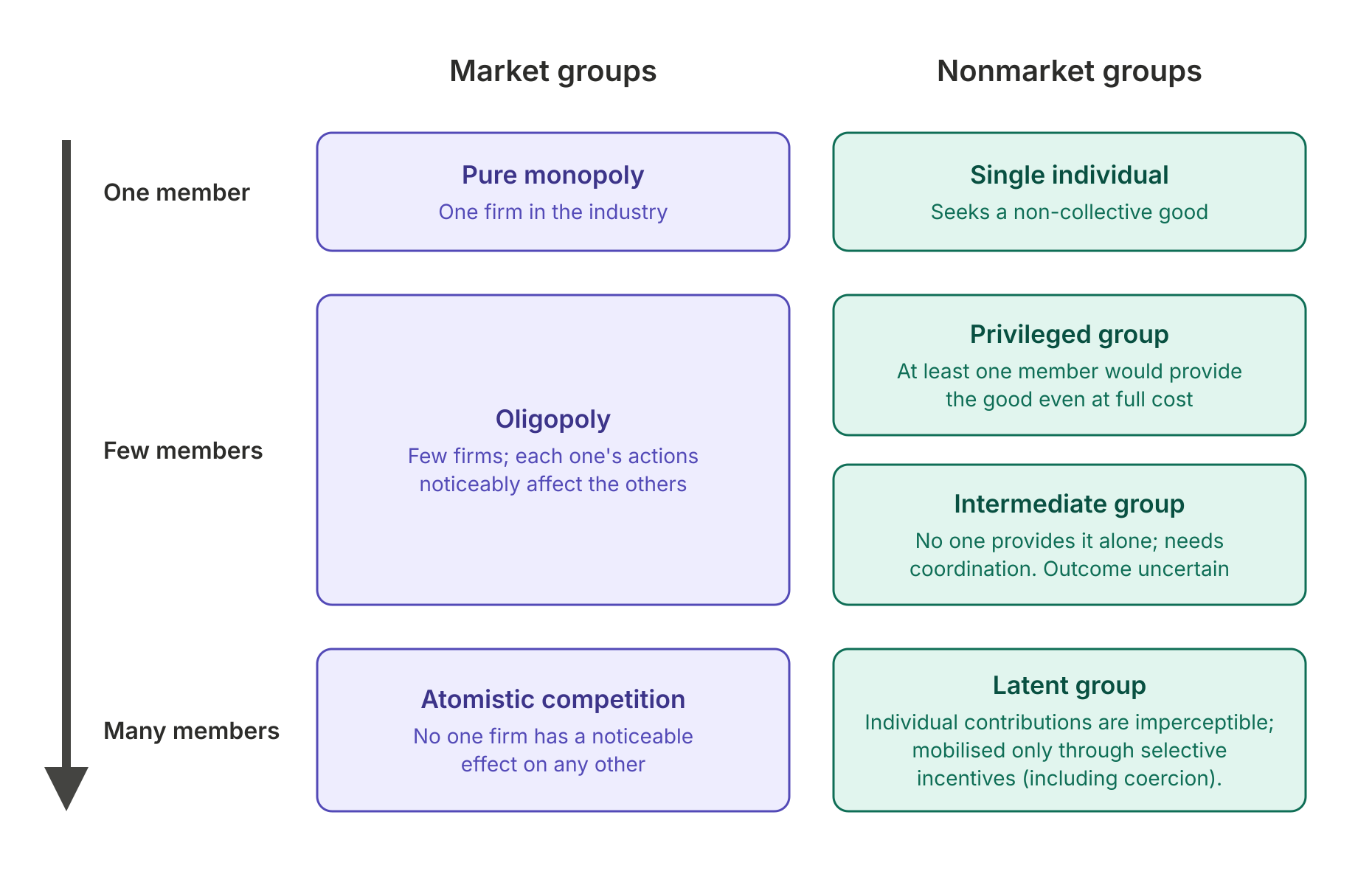
The book focuses on the Non-market groups on the right, but I’ve included Market groups on the left to show what Olson has based his taxonomy on.
Privileged, intermediate and latent groups
On one end of the spectrum, some small groups are able to supply themselves with collective goods even without any coordination. This is because an individual member’s share of the collective good’s benefits can sometimes exceed the total cost of providing the good. Olson calls these privileged groups, as they will usually be able to provide some collective goods.
Example: Privileged group providing collective goods
Assume a collective good provides total benefit of 100 and member A gets 40% of that. So long as the collective good costs less than 40, it will most likely exist, because A alone should be willing to pay up to 40 to provide it.
Contrast this with a larger, equal group where each member’s share of the benefit is only 10. Any individual member would not be willing to pay more than 10 to provide the good.
Still, the amount of collective good provided will be sub-optimal because the largest member stops once the cost of an extra unit exceeds their share of the marginal benefit.
As the group gets larger, each member’s share of the group benefit shrinks, so it becomes less likely that any individual’s share will exceed the total cost of the good. Intermediate groups are those where no individual member’s share of the group benefit exceeds the fixed costs of providing the collective good, but each individual’s contribution is still noticeable to others. Group members can therefore bargain or make their contributions conditional on each other’s. In such groups, the collective good may or may not be provided, depending on how bargaining goes. There’s no presumption either way.
At the other end of the spectrum are large, latent groups, which typically struggle to provide any collective goods. In latent groups, any individual member’s contribution is imperceptible to others, so no one has any reason to react. Only a separate, selective incentive (see below) can get latent group members to act in the group interest.
Example: Smaller groups get things done
The decisions that come from meetings could be considered collective goods to the participants. When there is a large meeting, the typical participant knows that their own contribution will probably make little difference to the meeting outcome, so will not make as great an effort to study the issues as if they’d had to make that decision alone.
This is partly why organisations often turn to smaller groups (e.g. committees and sub-committees) when they want things to get done, and larger groups when they don’t want action but are just looking for points of view and reactions. One study within a large bank found that “action taking” subgroups averaged 6.5 members, while “non-action taking” subgroups averaged 14 members.
Inequality can increase the chance of collective good provision
In an unequal group, the largest share of the collective good enjoyed by a single member (usually the biggest one) is more likely to exceed, by itself, the total cost of providing the good.
There is therefore a tendency in such groups for the largest member to bear a disproportionate share of the costs. Olson calls this the tendency for “exploitation” of the great by the small (but not in the pejorative sense). If the good will be provided by the largest member in any case, the smaller members will rationally hold back their contributions.
Costs and group size
Collective goods often come with fixed costs, such as setting up an organisation. In larger groups, those are likely to be greater than any individual member’s share of the group benefit, so it is harder to pass that initial hurdle.
However, larger groups can enjoy advantages of economies of scale. As the group scales, the total costs of organisation (including coordination and bargaining costs) will likely increase as the group gets larger. But organisation costs per member might not increase and may even decrease.
Selective incentives are required to mobilise latent groups
What are selective incentives?
Selective incentives are incentives that distinguish between individuals who contribute to the common interest and those who do not. They can be positive (rewards) or negative (punishments), and can include social or moral incentives. Prestige and self-respect are non-collective goods because contributors get them and shirkers don’t. But social incentives are mostly only effective in groups small enough for all the members to know each other.
— Mancur Olson in The Logic of Collective ActionIt is in the nature of social incentives that they can distinguish among individuals: the recalcitrant individual can be ostracized, and the cooperative individual can be invited into the center of the charmed circle.
Olson points out that the nature of collective goods is such that everyone in the group must get them if anyone is to get them. As such, they are “inherently unsuited to the market mechanism”, and some restriction on freedom is inevitable. That restriction can be imposed either by public institutions (e.g. government) or private ones (e.g. labour unions).
Socialistic incursions: a paradox?
While many governmental goods and services are collective, governments can also (and do) provide non-collective goods without impinging on economic freedom.
This creates something of a paradox:
- The government restricts freedom the most when it provides collective goods and services that even fiscal conservatives usually agree it should provide (e.g. defence and law and order).
- However, government activity that is more likely to be protested for being a “socialistic incursion into the private economy” may not restrict economic freedom at all. (Though Olson admits some government activity in this space can restrict economic freedom, such as if the government distributed non-collective goods for free.)
— Mancur Olson in The Logic of Collective ActionCollective bargaining, war, and the basic governmental services are alike in that the “benefits” of all three go to everyone in the relevant group, whether or not he has supported the union, served in the military, or paid the taxes. Compulsion is involved in all three, and has to be.
The by-product theory
All large economic groups with significant political power in the US were initially formed for some other purpose. That’s because large groups usually require compulsory membership to function effectively, but it would be strange in a democracy to allow a purely political organisation to force membership. So there is normally some non-political reason for the group to exist and force membership in the first place, and the political lobby is then a by-product of the organisation’s primary functions.
Some organisations also make “tied sales” of collective goods with non-collective goods. Many organisations therefore combine lobbying with economic and/or social functions.
Practical applications of Olson’s theory
Labour unions
Unions started out small
Labour unions were probably the single most important pressure group in America at the time of Olson’s writing. There were about 60,000 to 70,000 union locals in the country, with labour leaders claiming they could influence about 25 million voters.
Yet the first labour unions started out as small, local organisations, which attracted members by offering social and recreational benefits. Early unions that focused primarily on politics had little power or stability. Unions in large factories were actually among the last workplaces to organise.
Over time, as improvements in transportation and communication expanded market sizes, the incentives for unions to grow and for smaller unions to federate also increased. Unions only gained real power once they could force employers to only hire their members.
Large unions depend on compulsory membership
As unions grew larger, they couldn’t provide the social and recreational benefits that they could when they were small. So they had to rely on compulsory membership, and correspondingly compulsory participation in strikes, if they were to fulfil their function.
— Henry George, as quoted by Mancur Olson in The Logic of Collective ActionLabor associations can do nothing to raise wages but by force; […] Those who tell you of trades unions bent on raising wages by moral suasion alone are like those who would tell you of tigers who live on oranges.
Workers won’t volunteer but will vote for compulsion
Participation rates in unions tend to be low. Studies have often shown that less than 5% of members attend meetings or willingly participate in union affairs. Yet over 90% of members consistently vote to support compulsory union membership and dues.
Olson argues that workers are being both rational and consistent here. Members recognise that they are better off with a strong union, but individually they have no incentive to attend meetings or do voluntary work for it.
Labour unions made their strongest gains in the US between 1935 and 1945. The 1935 Wagner Act gave considerable power to unions, and specifically allowed the “closed shop” whereby certain jobs were only open to union members.
Some libertarians oppose closed shops on the basis that they violate people’s “right to work”. Olson, however, points out that compulsion is simply necessary for unions to survive, and that the same principle, applied consistently, would rule out compulsory taxation and conscription. It would therefore be better not to argue about “rights”, but simply whether the country would be better off with stronger or weaker unions.
Unions and selective incentives
In the past, unions have also used positive selective incentives to attract members. For example, the early railroad unions offered insurance to members, which was quite attractive as accident rates were high and insurance was otherwise hard to get. Other selective benefits offered by unions include things like handling members’ employment grievances, or helping members find employment.
But later developments made it harder for large unions to attract members through selective incentives. The growth of government-sponsored and private insurance reduced the demand for union insurance schemes. Later laws also forced unions to fairly represent workers that weren’t members of them.
Professional associations
Membership of some professional associations is compulsory for those who want to work in the field. Classic examples include law and medicine. But compulsory membership in an association has increasingly spread to other occupations including undertakers, barbers, beauticians, and plumbers. Some have called this a return of the “guild” form of organisation that was popular in the middle ages.
Professional associations now are starting to resemble mini-governments, with powers to discipline members that do not uphold the profession’s ethical standards. These disciplinary powers can inflict severe economic consequences on members.
Example: Doctors vs Professors
The American Medical Association (AMA) provides its members with non-collective benefits in the form of malpractice insurance. Doctors who don’t join the AMA can also struggle to find other doctors to testify as expert witnesses for them during malpractice suits. Membership of the AMA also comes with access to a top-tier medical journal. The AMA’s lobbying power is a by-product of its other functions.
In contrast, the American Association of University Professors (AAUP) is solely a union for college professors, and doesn’t provide significant non-collective benefits to members. Professors don’t need professional insurance, and they subscribe to technical journals for their own subjects produced outside the AAUP. As a result, the AAUP is not nearly as well organised and powerful as the AMA.
— Mancur Olson in The Logic of Collective ActionMany of those who criticize organized labor because of the coercion entailed in labor unions are themselves members of professional organizations that depend upon compulsion as much as unions do.
Business interests
Business interests tend to be better organised and wield power disproportionate to their size. However, this only applies to particular industries. As a whole, the business community is a large, latent group, and faces the same mobilisation challenges as other large groups in society. The two organisations that purport to represent US businesses as a whole — the National Association of Manufacturers (NAM) and the Chamber of Commerce — rely heavily on a small group of giant businesses, and are not disproportionately powerful compared to the lobbies representing labour, specific professions, or farmers. Around 5% of the NAM’s members contribute about half the money.
When you turn to particular industries, however, lobby groups hold outsized power. This is because many industries are oligopolistic, with relatively few firms. For example, the median US trade association for metal and wood products had between 24 and 50 members. Another researcher found that the active or supporting membership in these trade associations was smaller still — often just a handful of members bore almost half the costs of the association.
Olson notes that this fits his theory: special business interests do win tax loopholes, favourable tariffs, and generous regulatory policies. Yet the business community as a whole has not stopped the trend towards social-welfare legislation and progressive taxation.
Farmers
Farmers on the whole have not been well organised. Though farmers were the largest group by population in the early history of the US, it wasn’t until 1867 that the first significant farm organisation got started. Most US farm organisations since then have died within a few years of their founding, and those that didn’t have still been relatively weak political forces.
One major exception to this is the Farm Bureau. The government effectively created the Bureau to provide farmers with non-collective benefits like technical assistance and education. But as the Bureau gained political power, the extent to which public funds could be used for lobbying was limited.
Its membership now seems to come mostly from its provision of non-collective benefits, rather than its lobbying. The two largest car insurers in the US in Olson’s time — State Farm and Nationwide — started out selling insurance to Farm Bureau members.
Political parties
US political parties are surprisingly weak as formal organisations, because they mostly seek to provide collective benefits. Despite their importance, they don’t have many “members” or large staffs, and even their supporters make relatively minor sacrifices for them. The average supporter doesn’t donate or attend precinct meetings.
Supporters who do contribute significantly tend to get non-collective benefits. Those with personal political ambitions can improve their chances of getting public office (there are hundreds of thousands of elected officials in the US). And businessmen may contribute to get individual access to officials on matters affecting their businesses.
[Makes me think that one advantage of elections and (especially) referenda is that they enable large latent groups’ common interests to influence policy without too much required in the way of mobilisation. Even if the effect of any single vote is imperceptible, the cost is so small that a sense of civic duty or self-expression can still be enough.]
Large, unorganised groups
A key point in Olson’s theory is that the political struggle between groups is not symmetrical. Perhaps the best illustration is the largest groups of all, such as consumers and taxpayers, which have no organised lobby. [This is no longer true, as there are both consumer and taxpayer lobby groups in the US today. But Olson’s theory still fits. Members join the Consumers Union to get the magazine, and the lobbying is a mere by-product of that. Meanwhile, taxpayer groups like Americans for Tax Reform represent a very narrow and unrepresentative slice of taxpayers as a whole — which also supports Olson’s theory about how the members with the largest individual stake carry most of the cost. And both groups have little political power, relative to the numbers they purport to represent.]
In a democracy, the will of large groups is supposed to prevail. But in practice, smaller, better organised, groups will often defeat it.
Other Interesting Points
- Olson does a brief survey of what earlier economists and theorists had to say about the role of the state in the provision of public goods. Some of them understood bits and pieces but made various mistakes.
- Olson also surveys other theorists’ views of pressure groups, some of whom defended or even glorified the role of pressure groups in society. David Truman (The Governmental Process), for example, was so confident that group pressures were benign that he belittled almost all attempts to improve the system of legislation and lobbying.
My Review of The Logic of Collective Action
The Logic of Collective Action is short and surprisingly easy to read for an academic-flavoured book from the 1960s. There’s a bit of maths in the beginning when Olson explains the differences between large and small groups, but you don’t really need to follow it to get the underlying idea.
The book is well-structured and clearly argued. For someone reading today who is already familiar with the problems of “concentrated costs, diffuse benefits”, Olson’s points may seem rather obvious, perhaps even over-argued. But Olson’s survey of other group theorists suggests that his ideas may have been rather novel at the time.
In any case, I for one still found Olson’s framework enlightening. Before reading this, I already knew about free-rider problems and was already sold on the idea of coordination being easier in smaller groups than in larger ones. But I hadn’t thought of “selective incentives” as such, or the by-product theory. I particularly enjoyed the parts where Olson analysed real-life groups according to his theory. His stuff on unions was surprisingly sympathetic, as I’ve often seen him cited by people with more libertarian views. For example, I hadn’t previously thought of the parallels between labour unions and professional associations. (I understand that Olson’s later book, The Rise and Decline of Nations, is harsher on unions, though.)
I can see many more areas in which Olson’s framework could provide a useful lens. For instance, Olson co-authored a separate paper on geopolitical alliances, which seeks to explain large countries tend to disproportionately bear the costs for organisations like the UN and NATO — with the disproportionality paradoxically increasing with the level of alignment between the allies. One example I thought of was the recent discourse on the amounts of wealth held by “main street millionaires” vs billionaires. Even though the former holds more wealth in aggregate, Olson’s theory suggests that billionaires may nevertheless distort politics more. I’m sure there are many more examples to be found.
Let me know what you think of my summary of The Logic of Collective Action in the comments below!
Buy The Logic of Collective Action at: Amazon <– This is an affiliate link, which means I may earn a small commission if you make a purchase through it. Thanks for supporting the site! 🙂
If you enjoyed this summary of The Logic of Collective Action, you may also like: